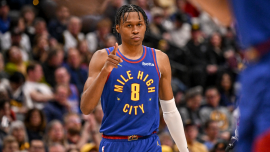
The NBA’s second apron claimed its newest victim on Wednesday, as the Denver Nuggets traded Peyton Watson to the Cleveland Cavaliers in an $88 million sign-and-trade deal that brought no active players back to Denver. They acquired a 2031 first-round selection from Cleveland and a 2032 second-round choice via Sacramento, leaving them without an immediate substitute for Watson. By Friday, their focus shifted to DeMar DeRozan. Looking at 2026, replacing Watson with DeRozan represents a step backward. If you think different, to use modern slang, you don’t understand the game.
Avoiding the second apron is obviously the primary goal for the Nuggets. They are certainly not the only franchise taking this path. The Knicks captured the title last season and promptly allowed Mitchell Robinson to leave in free agency because owner James Dolan characterized crossing into the second apron as “suicidal.”
Evaluation of the Peyton Watson trade: Cavs secure rising star on the wing, while Denver faces major uncertainties surrounding Nikola Jokić
Sam Quinn
Robinson joined the Celtics, a franchise that has parted ways with Jaylen Brown, Jrue Holiday, Kristaps Porziņģis, Al Horford, and Luke Kornet following their 2024 championship run. Oklahoma City captured the 2025 title and subsequently watched Aaron Wiggins, Lu Dort, and Isaiah Joe depart this offseason. Meanwhile, the Warriors continue to frustrate their fanbase by maintaining an extremely conservative financial approach since their 2022 championship. Similarly, the Bucks have completely dismantled their roster since winning the title in 2021.
Ultimately, while one could argue the second apron has simplified building a championship contender by dispersing talent more evenly throughout the NBA (indeed, at least 13 franchises are entering the upcoming year with rosters capable of reaching the conference finals), it has simultaneously made preserving those same rosters more difficult than ever before for that very reason.
Seen from this perspective, Denver’s loss of Bruce Brown, Kentavious Caldwell-Pope, Michael Porter Jr., and now Watson from their 2023 championship squad is not an exceptional failure. It is a fate shared by nearly every roster, unless they benefit from unique salary anomalies—such as Jalen Brunson taking less money to help the Knicks, Stephen Curry playing on an incredibly cheap deal signed back in 2012, or the Spurs managing Victor Wembanyama (who eventually agreed to a team-friendly long-term extension with San Antonio), Stephon Castle, and Dylan Harper on rookie-scale deals simultaneously.
Consequently, success depends entirely on making smart decisions with minor roster adjustments. While navigating this path requires precision, supporters look at organizations like OKC—which executed flawless acquisitions like Alex Caruso and Isaiah Hartenstein, selected Cason Wallace in the draft, and successfully developed Ajay Mitchell—and expect similar results from their own management. This level of depth allowed the Thunder to lose a starting contributor like Dort and a versatile wing like Wiggins, two assets any other squad would love to have, without losing any momentum.
This is precisely where the Nuggets’ front office has missed the mark. Once again, they failed to secure an adequate replacement for the 2023 version of Brown. They declined to match the salary demands of Caldwell-Pope. Their attempt to trade Porter Jr. for Cam Johnson under the assumption that they were similar archetypes backfired, as Porter Jr. proved to be the vastly superior player. Now, they have parted with Watson, their sole young, dynamic athlete who offered a realistic avenue for growth after last season’s early playoff exit, largely because they signed Christian Braun to a $125 million extension—at least twice his market value—and refused to endure another luxury tax clearance.
The issue is that Watson’s new contract pays him “just” $22 million per season, which is typical for a solid starter rather than an elite star. Since Watson deserves that role, and given that Denver was already operating above the second apron and consequently handcuffed by the accompanying team-building limits, why didn’t they simply retain him?
To begin with, spending is easy to advocate for when you aren’t the one signing the checks. Even though the Kroenke group boasts a net worth near $40 billion, allowing the team’s 2026-27 salary obligations to soar beyond $400 million—a record-setting figure in the NBA that Denver would have incurred by keeping Watson at the price Cleveland paid—hardly seems like a logical choice for a roster that might still miss the mark of a true championship threat. It simply isn’t justifiable.
Should they have proceeded regardless? That would warrant a clear negative response if Denver wasn’t currently anchored by Nikola Jokić performing at his absolute zenith. But because they possess him, the situation becomes highly complicated.
The franchise superstar predicament
When your roster features more than just a typical star—specifically, a generational franchise pillar—supporters will refuse to tolerate anything resembling corporate complacency or perceived ownership frugality. It is unfair to label Denver as entirely inactive; on the contrary, one should praise the franchise for maintaining roster stability since acquiring Aaron Gordon, a strategy that has clearly paid dividends. Furthermore, accusing ownership of penny-pinching is difficult when they are prepared to pay the repeater tax with a payroll bordering on $300 million next season.
Even so, the Nuggets have undeniably trimmed expenses since winning the title in 2023, a pattern that persists today. Supporters will understandably reject these cutbacks when their draft-and-develop future Hall of Famer remains arguably the premier player on Earth and is poised to enter free agency next year. In an ironic twist, employing a player of this stature transforms from a privilege into an immense burden, forcing the front office to pursue a championship annually even as the foundation begins to erode.
If handled poorly, it can turn into a disastrous endeavor. Consider the Bucks, who sacrificed nearly all their future assets trying to keep Giannis Antetokounmpo happy on a squad whose championship window had shut tight. They ultimately waived and stretched Damian Lillard’s contract over five years, committing $113 million for him to suit up for Portland, solely to hand Myles Turner a contract worth over $100 million. Ultimately, they were forced to trade Giannis regardless, leaving them to deal with the financial repercussions for the foreseeable future.
That choice ought to have been straightforward, as Milwaukee’s run was over. Denver’s window is still open, or at least it could be, though their room for error is virtually non-existent now that younger, ascending giants like San Antonio and Oklahoma City have taken control of the Western Conference. Trading Watson was a boundary decision. He has only 64 career starts under his belt. While he enjoyed a strong run last year where his capability was on full display and his defensive and offensive potential is clear, it is understandable to hesitate on an $88 million gamble—particularly when weighed down by Braun’s deal as the lone second-apron team in basketball while lacking realistic championship prospects.
To be fair, looking at each minor roster move the Nuggets have executed over the past four offseasons individually, none appear completely irrational.
- Losing Brown was a massive blow, but Denver lacked the ability to retain him in 2023 due to a lack of early Bird rights, which restricted the salary bump they could put on the table. Once the Pacers extended a two-year, $45 million offer, Denver was effectively priced out unless Brown decided to accept a salary reduction of roughly $15 million in year one.
- The $66 million deal Orlando handed to Caldwell-Pope quickly proved to be an overpay.
- While trading Porter for Johnson appears misguided in retrospect, consensus at the time suggested Porter was an overpriced third option, whereas Johnson, coming off a season averaging 19 points per game with a 39% success rate from deep in Brooklyn, offered similar production at roughly half the expense.
Any lingering disappointment stems from the cumulative effect of these collective concessions. Alongside Watson, the team also parted ways with Jonas Valanciunas, who offered some stability during the non-Jokić stretches that have long plagued the Nuggets, as well as Sixth Man of the Year runner-up Tim Hardaway Jr.
It is understandable if the fanbase struggles to find enthusiasm in the arrivals of Tyus Jones and Marvin Bagley Jr., and if they are beginning to silently fret over a scenario that once seemed entirely impossible.
Will Jokić remain a Nugget for life?
Indications still suggest he will. A couple of months back, Jokić expressed to Serbian journalists that his “desire is to play the rest of my life in Denver,” adding that he would “probably [re]sign [with the Nuggets] next year.” While that probably might raise a small flag, his choice to bypass the $278 million extension offered this past offseason is almost certainly a strategic financial move. He will be eligible for a $359 million contract next summer, which he is highly expected to sign. He has shown no desire to look elsewhere.
The real worry is whether Denver’s front office is capitalizing on Jokić’s loyalty, using his lack of exit threats as an excuse to scale back their aggressive roster building without worrying about the fallout. This dynamic is precisely what has infuriated supporters in Golden State. A front office managing a team with LeBron James would never stockpile future assets to plan for the future because James would pressure management relentlessly behind the scenes. Stephen Curry, on the other hand, avoids such power plays, consistently voicing his commitment and backing for every move made by management, even if it compromises his final opportunities to win a title.
Jokić has historically seemed to share that easygoing demeanor. However, equating his calm attitude with a lack of drive to win would be a serious error. The popular narrative that he is indifferent to winning, or values his horses far above his NBA career, is more of a romantic myth than actual fact. While it is amusing to picture a legendary talent who does not care, it does not reflect his true competitive nature. He wants to win championships, and he wishes to do so with Denver. Yet, as the supporting cast grows older, that goal appears increasingly out of reach. Relying on the hope of perfect health for Aaron Gordon is a narrative with an expiration date.
Ironically, Curry’s Warriors could emerge as a viable destination with enough cap space to sign Jokić next summer if they carefully structure their finances. There is no doubt Joe Lacob is imagining that pairing right now, even if its likelihood mirrors their past pursuit of Giannis.
The far more plausible outcome is Jokić remaining in Denver as the team slowly slips out of the elite tier, unless they pull off a major transaction to revitalize the roster—such as moving Jamal Murray or Gordon before the trade deadline, or packaging that newly acquired 2031 Cleveland selection alongside Braun or Johnson’s expiring contract to secure an impactful veteran.
We will see how the situation unfolds. In all likelihood, Jokić is set on staying in Colorado regardless. Still, if you wanted a textbook strategy to make your franchise cornerstone look for the exit, letting three key contributors walk away and bringing in someone like Marvin Bagley as a replacement is exactly how you would do it. This does not guarantee Jokić will demand a trade, but for now, it feels as though the front office is testing his loyalty.