The ongoing dispute over Michigan’s victory against Western Michigan remains highly active.
Though the Mid-American Conference first went along with the Big Ten’s rationale regarding the extra second put back on the clock—enabling the Wolverines’ game-winning Hail Mary pass to seal a 13-12 decision over the Broncos—the MAC released a statement on Tuesday declaring that replay guidelines were violated and Western Michigan deserved the win.
“Following a deeper review and analysis, it has become clear that the replay procedure was incorrectly applied when assessing whether any time was left on the clock at the end of the Western Michigan-Michigan matchup,” the statement read.
“Standard replay rules mandate using the game clock shown on the broadcast feed to decide if time was left. Instead, the Big Ten replay officials used the clock integrated into their own replay system. Because of this, one second was restored to the clock, allowing for an extra play.
“This is not a matter of disputing a subjective call about how much time was left. It was a failure to follow the mandatory replay protocol designed for these final-second situations. If the correct rules had been observed and the broadcast feed clock had been consulted, the game would have ended right there, giving Western Michigan a 12-7 victory.
“Consequently, the Mid-American Conference has filed official appeals with the NCAA FBS Oversight Committee and the College Football Playoff. The MAC asks that these organizations designate Western Michigan as the rightful winner of the matchup when conducting their rankings, evaluations, and postseason selections, while implementing any other appropriate remedies under their jurisdiction.”
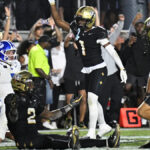
Michigan’s first Hail Mary pass fell incomplete as the clock apparently expired, but referees put a single second back on the clock after ruling that Western Michigan’s Micah Davis—who had jumped from out of bounds—made contact with the ball before the game ended.
In the official petition sent to the FBS oversight committee, MAC Commissioner Jon Steinbrecher pointed out that standard review rules require the stadium’s game clock to be overlayed on the broadcast feed, emphasizing that replay coordinators must decide on timing adjustments using only that specific on-screen broadcast clock.
On the NBC television broadcast, the overlaid clock showed 0:00 at the moment Davis made contact with the ball. However, in its post-game clarification issued hours later, the Big Ten pointed to a dedicated camera feed inside their replay headquarters that still showed one second remaining.
“Instead of consulting the required game clock shown on the TV broadcast, the Big Ten’s review team used an independent clock built into their replay program. These two timekeepers were not in sync,” noted the MAC.
“The broadcast-feed clock clearly indicated that the game was over. In contrast, the internal replay system clock still had time left. Even though the rules explicitly demand that officials make decisions based exclusively on the television feed clock, the crew used the non-synchronized system clock to put time back on the board.”
The conference argued that the final result was not altered by a subjective referee decision allowed under the rules, but rather “by a failure to adhere to the mandated process for assessing remaining time, substituting the designated official protocol clock with an unsynchronized alternative.”
This formal challenge by the MAC was launched two days after Western Michigan President Russ Kavalhuna and head coach Lance Taylor spoke to reporters, stating they would accept the Big Ten’s justification for how the extra second was determined.
“It is obvious that what TV viewers see differs from what the officiating crew sees,” Kavalhuna stated on Sunday. “I have examined this matter in detail, and with my background as a former federal prosecutor, I do not see any signs of malice or dishonesty. Perhaps the system could be enhanced by aligning the viewer’s feed with the official replay feed, but that is not my call to make.”
Following Tuesday’s announcement by the MAC, Kavalhuna described the conference’s intervention as a “crucial move.”
“Today, Commissioner Steinbrecher and the MAC have made a significant move for the sport,” Kavalhuna stated. “We are deeply appreciative of the incredible wave of national support for Coach Taylor and our team, celebrating their integrity and competitive spirit.
“While some might misinterpret our posture as passive, standing by our student-athletes and guiding them through difficult situations is a sign of true resilience. Choosing not to be resentful is not the same as agreeing or backing down. It is entirely possible to respect the sport while demanding answers, which is exactly what we are doing. At Western Michigan, our focus is on competing and developing our young men, while the conferences and the NCAA are responsible for upholding the rules. Our team is ready to play whoever is on the schedule.”
During halftime of Sunday’s Washington-Washington State broadcast, NBC clarified in a statement that its broadcast cameras are not the official timekeepers and that game timing falls solely under the purview of the Big Ten and its crew. Although NBC’s broadcast clock seemed to start prematurely before the ultimate play, a definitive conclusion was difficult to reach due to various complicating factors.
In college football, stadium clocks do not measure tenths of a second, and the Big Ten has yet to publish a comprehensive, synchronized split-screen video of the entire play. The footage released by the conference late Saturday evening merely captured the final moments in the end zone as players contested the pass thrown by Michigan quarterback Bryce Underwood.
Following his deep heave to the back of the end zone on the initial attempt, Underwood directed his second pass toward the goal line, where JJ Buchanan secured it to clinch the victory for Michigan.