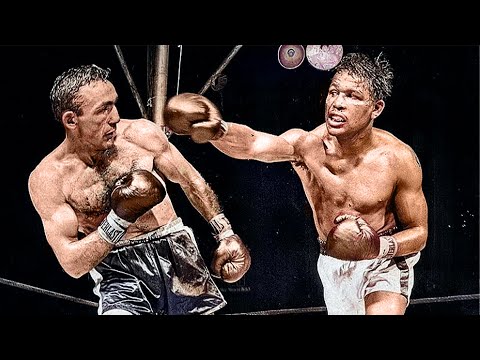
Less than five months prior, Sugar Ray Robinson had stopped Gene Fullmer with a devastating left hook. Carmen Basilio was fully aware of the threat. Moving up from the welterweight class to battle Robinson at Yankee Stadium on September 23, 1957, he spent all 15 rounds depriving the middleweight champion of the space needed to set up that signature blow.
Robinson held a height advantage, weighed six pounds more, and was highly dangerous whenever he could establish his jab, pivot, and strike from his preferred range. Basilio’s goal was to ensure those opportunities were rare. Stalking from a low crouch, he targeted Robinson’s midsection and remained close enough to initiate quick inside exchanges. A punch to the ribs did not need to drop Robinson to be effective; every body blow made it more difficult for the champion to keep his guard up and easily glide out of range.
The ring boundaries became critical territory. Basilio found his greatest success by tracking Robinson’s escape routes and crowding him before the champion could fully extend his arms. By eliminating the distance between them, Robinson’s superior reach was neutralized. Basilio’s short, tight hooks and relentless activity instead took center stage.
Even so, Robinson still connected with the more eye-catching and precise blows to the head. Basilio withstood these shots and countered with his own offensive bursts. Neither combatant was knocked off his feet. This clash of styles illustrates why the decision is still debated: a crisp combination from Robinson could easily catch the eye, whereas Basilio spent the rest of the round pressuring, landing blows, and preventing the champion from planting his feet.
By the 11th round, Basilio had cornered Robinson against the ropes and was letting fly with inside combinations. Robinson mounted a comeback in the 12th, offering a reminder that Basilio had not completely solved his boxing wizardry or neutralized his punching power. However, the contest repeatedly drifted back into the grueling, physical exchanges that the smaller challenger had pursued from the opening bell.
At 36 years old, Robinson possessed the ring wisdom to counter Basilio’s offensive surges. Yet, he was never granted a single easy round. Basilio forced him to struggle for breathing room whenever they separated, only to immediately chase him down again. This continuous, relentless pressure—rather than a single decisive punch—formed the strongest argument for the challenger’s victory.
Referee Al Berl carded the matchup nine rounds to six for Robinson. However, both judges favored Basilio, who claimed the middleweight championship via a split decision. Among 47 ringside journalists surveyed, 26 sided with Basilio, 17 selected Robinson, and four scored it a draw. The split outcome highlighted a real divergence in what spectators prioritized: Robinson’s crisp, clean strikes versus Basilio’s ability to drag the champion into a short-range battle.
Basilio’s historic win in front of 38,072 spectators earned the contest The Ring’s 1957 Fight of the Year honors. Robinson won back the crown in their rematch the following March. While that second encounter also received the same award, Basilio’s initial victory stands as the night he forced one of boxing’s most elusive movement specialists to fight almost entirely on his terms.
Archival photo restored using AI.