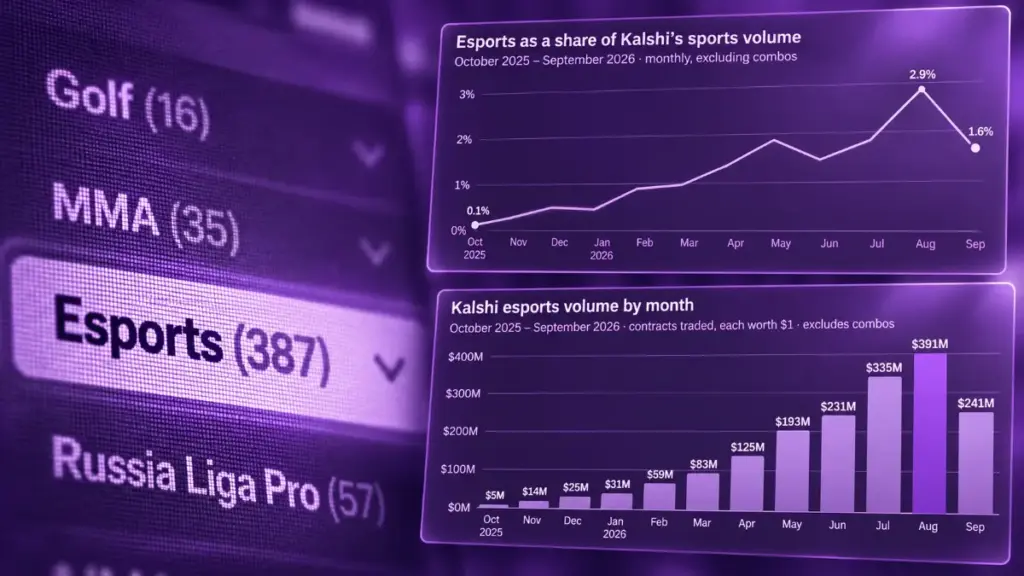
Prior to October 2025, Kalshi witnessed esports contracts trading under $0.4 million monthly. By August 2026, this figure surged to an impressive $391 million on the platform. Over the year leading up to September, the total esports volume reached an impressive $1.73 billion.
While it constitutes a minor component of a much larger ecosystem, it is sufficient to demonstrate that enthusiasm for esports persists– regardless of contrary opinions.
The Year of the Prediction Market
If we substitute the Chinese Zodiac signs with terms from the gambling realm, 2026 truly represents the year of the Prediction Market. Prior themes may include: NFTs, cryptocurrency, online poker, lotteries, and social casinos. The list could endlessly expand. If I were a trader, I would be putting my bets on yes for “rug pulls” to emerge as the hot topic in 2027.
If you’re involved in the gambling sector, you’re likely quite familiar with the ongoing narratives surrounding Kalshi, Polymarket, and the increasing number of platforms competing for their share. They’re battling legal actions from state gambling bodies, initiating lawsuits against them, and generally operating in a manner that takes advantage of the rather chaotic regulatory landscape in the United States.
Nonetheless, prediction market data can be accessed through APIs, and with an adequate understanding of what you’re after, there are intriguing insights and signals to uncover. While they may not serve as the absolute “truth” indicator that some may claim, they indeed yield data that can be beneficial for analyzing consumer behavior.
Kalshi esports volume surged around EWC and major tournaments
The platform’s inaugural esports offering in the fall of 2025 featured a market for “who will win the League of Legends Worlds.” This ties in with our data collection: League of Legends accounted for nearly all of the $5.2 million traded in October 2025.
Markets for individual matches soon appeared for titles like Counter-Strike 2, League of Legends, Valorant, and Dota 2, with volume steadily increasing each month thereafter. The platform’s esports trading reached $44 million in the last quarter of 2025, climbed to $173 million in the first quarter of 2026, further rose to $549 million in the second quarter, and ultimately hit $967 million by the third quarter.
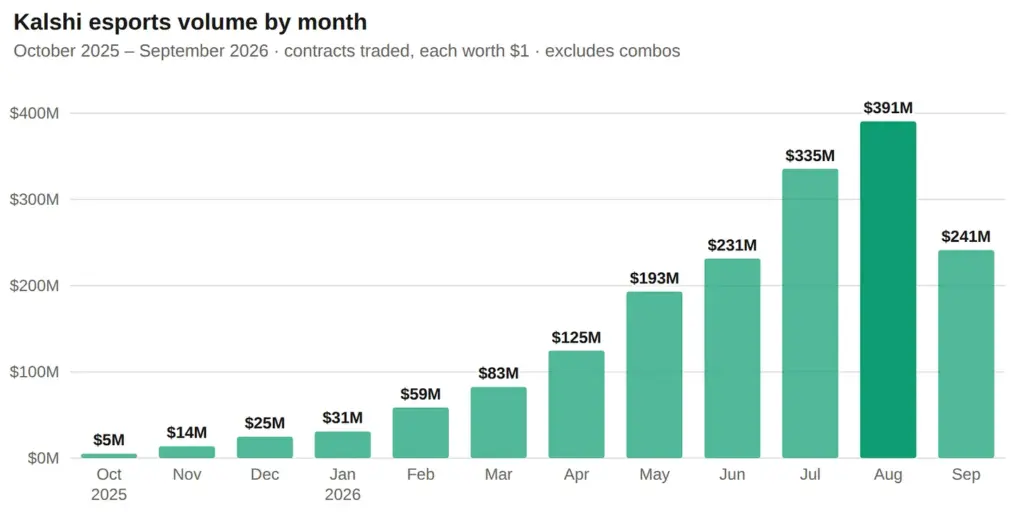
It’s evident that trading volume surges during major events. This was highlighted by the substantial trading activity seen in soccer during the FIFA World Cup. In esports, the pattern appears comparable, although I would argue there’s solid foundational growth alongside spikes linked to significant events.
June featured the IEM Cologne Major (Counter-Strike). August brought the Esports World Cup (CS Finals) and Dota 2’s The International. The combination of these two prominent events in August led to record levels of activity, with North America’s fondness for Counter-Strike resulting in noteworthy numbers in June as well.
Remarkable Growth, Yet a Small Portion of a Vast Platform
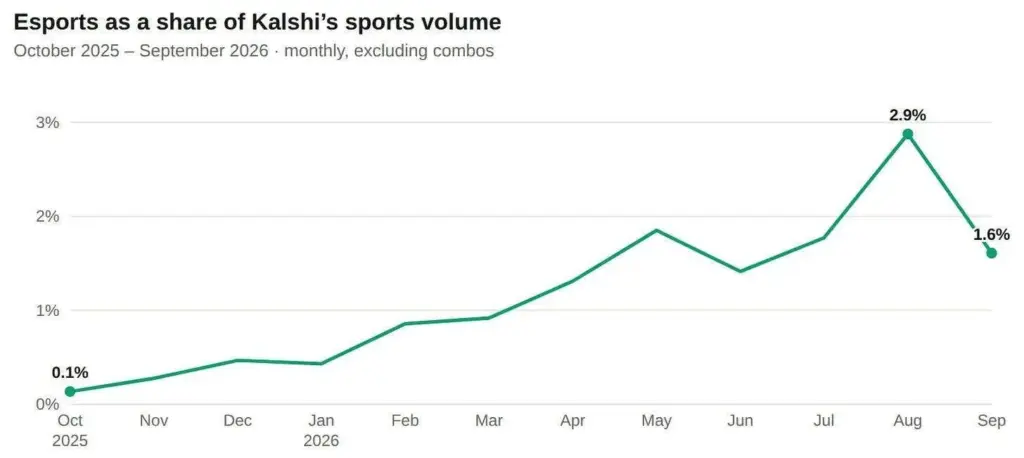
Esports is undoubtedly experiencing rapid growth from a minuscule foundation, and thus, placing this within the wider context of Kalshi is crucial. In October 2025, esports represented just 0.1% of Kalshi’s sports trading volume (excluding combinations).
At its zenith in August, esports constituted 2.9% of Kalshi’s single-leg trades, which subsequently dropped to 1.6% in September. Kalshi’s market dynamics are overwhelmingly influenced by combinations, as users tend to pile contracts into multi-leg configurations in pursuit of substantial returns from minimal wagers.
Essentially, it’s a speculative accumulator—UK readers are likely familiar with the thrill of placing a 12-leg accumulator on teams to score in a bid for a little excitement each weekend, only to never secure a win. Parlays constituted 58% of the overall volume on the platform in September.
It’s crucial to note that the volume transacted on a prediction market isn’t directly equivalent to the turnover indicated by sportsbooks. It measures the number of contracts traded, and the act of entering and exiting positions raises the numbers without requiring any additional funds being injected.
Initially, prediction markets were proposed as a niche for political and economic predictions. With the introduction of sports betting contracts, they swiftly transitioned into a popular method for individuals to speculate on sports outcomes in the United States, unbound by state-specific gambling regulations. Esports, as a legitimate ‘sport’, is starting to follow suit.
For those positioned within the esports sector, immediate advantages reside in the data—if only for affirmation. The volumes traded during specific events act as a reasonable gauge of audience interest. In the context of Kalshi, this is primarily directed toward a US demographic. It offers valuable data for event organizers, publishers, and sponsors, complementing viewership statistics to demonstrate that esports extends beyond mere chatter characterized by loud voices discussing the future. Or perhaps, it simply amplifies the noise.
League of Legends Worlds is Set to Generate Substantial Interest
I am confident that the League of Legends World Championships will yield impressive trading volumes. Given that the event is happening in the United States, it will serve as a reliable indicator of prevailing interest levels.
Historically, according to my analysis, Polymarket (Global) has been the primary platform for League of Legends trading, so I’ll be closely monitoring the figures as we move through the upcoming month. I’ve included a tracker in my Substack for those interested in the (very) preliminary data.