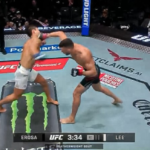
Canelo Alvarez effectively functioned as his own referee during the eighth frame on Saturday night when official Hector Afu penalized Christian Mbilli. As Mbilli unleashed a barrage along the ropes, Canelo crouched sharply, lowering himself toward waist level. A blow inadvertently struck the back of his head. Alvarez immediately turned around to protest, nudging Afu to demand a sanction, which was promptly granted moments later.
Commentators highlighted the clip across social platforms, framing the interaction as a lighthearted joke. Alvarez dictated the decision with a light tap and a motion, prompting Afu to react instantaneously much like an assistant following instructions.
In a correctly managed contest, the referee holds ultimate supreme authority inside the ring. The instant a marquee star can initiate physical contact, point his finger, and secure an immediate penalty against his opponent, that authority disappears completely. It thoroughly flipped the hierarchy of control.
Alvarez controlled the dynamics from inside the ring, leaving Mbilli to fight a rival who had virtually elevated himself to the role of head official.
While the strike hit an illegal area, Canelo brought it upon himself by dipping so far down. Whenever a fighter ducks beneath punches during an exchange, incoming strikes will naturally land behind the head. A referee must account for that context prior to docking points from the attacker.
Mbilli certainly needed to maintain control over his strikes. Accounts indicated that prior cautions had been issued before this dock, meaning the penalty did not occur out of nowhere. Nonetheless, the situation reflected poorly on Afu. A referee must direct the contest decisively without delay and should never wait for a marquee fighter to demand action before enforcing rules.
The subtracted point ultimately had no bearing on the contest’s result. Alvarez dominated the judges’ cards by a wide enough margin that a single point alteration was completely inconsequential to the outcome. Even so, the referee managed the scenario poorly. Alvarez was entitled to express his annoyance, but he should never appear to be the one directing the official.
This sequence left a cloud over the fight. When boxing fans reflect on a major match, moments of this nature tend to endure in memory far longer than standard rounds of action. Rather than focusing strictly on ring generalship or stamina, the discussion becomes dominated by the perception that the favored fighter held sway over the referee.
The reality is that regulatory rulebooks explicitly state that bending beneath a rival’s beltline is an infraction, designated as endangerment of oneself. A boxer who crouches at the waist eliminates the legitimate scoring area, causes an unnatural disruption in action, and generates the exact rabbit punch scenario Alvarez complained about.
Mbilli was opening up with his combinations against the trapped Alvarez along the ropes. When Canelo dropped his head down toward waist height, punches already thrown caught the back of his head. Mbilli was left with two unfavorable options: check his punches completely and allow Alvarez to slip away unpunished, or complete his combination and risk connecting behind the ear.
Afu was positioned directly beside the clash with a clear line of sight. An effective referee realizes that the boxer bending below the waist created the illegal contact. The appropriate response was straightforward: issue an immediate warning to Canelo for ducking dangerously low, rather than granting him a point deduction against the aggressor.
Instead, Alvarez turned the tactic into a double advantage. He evaded significant damage while pinned to the ropes, forced Mbilli to halt his attack, and secured an unearned point deduction after prompting the referee. This maneuver converted a clear defensive violation into an offensive gain.