Regarded as the pinnacle event on the Formula 1 schedule, the Monaco Grand Prix has historically presented formidable difficulties for over a hundred years. This season, however, these challenges will evolve due to new technical rules bringing in crucial aspects that will profoundly influence both driver safety and vehicle configuration.
It was announced on Friday that, for the initial time this championship year, active aerodynamic systems will be non-operational for the entire circuit to diminish potential hazards.
Typically, the FIA designates specific activation areas on the course where vehicles are not at their maximum grip threshold, meaning the tires are not enduring peak side or pulling forces. This practice guarantees the safe deployment of the wings, maintaining vehicle stability even with degraded tires.
Nonetheless, two supplementary conditions are now relevant. The designated activation area must last longer than three seconds, preventing short-lived activations that would heighten drivers’ efforts without providing significant advantages in either speed or fuel economy.
During the previous Monaco Grand Prix, competitors engaged the DRS on the main straight for slightly more than five seconds, achieving speeds around 290 km/h. Presently, the 350kW MGU-K unit provides considerably more power during acceleration, enabling vehicles to reach higher velocities more quickly.
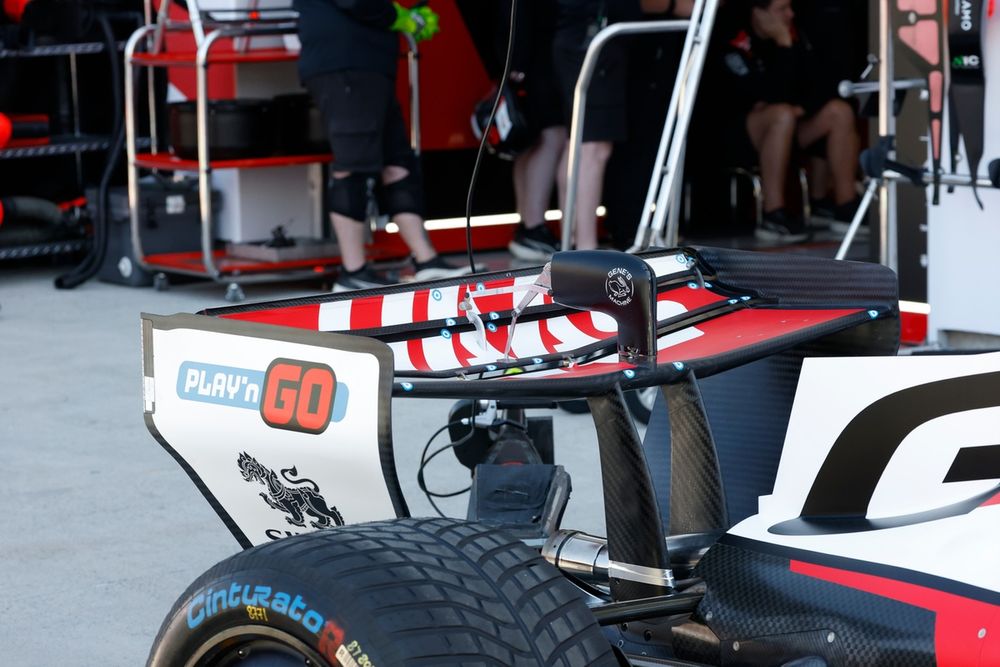
Haas VF-26
Photo by: Getty Images
Consequently, the aerodynamic wing would offer no true advantage. Given the increased danger of approaching the braking area for Turn 1, where an uneven track necessitates peak downforce to avoid wheel lock-ups, at an accelerated pace, the choice was made to disengage the ‘straight mode’ function.
Yet, this constitutes just one of several safety precautions. Owing to the inclusion of such a potent electric motor, certain Grand Prix events – Monaco being among them – will utilize a unique engine configuration known as Rev1, which implements a modified upper threshold for the MGU-K power output.
The primary objective is to curb excessive velocities in specific segments such as the main straight, the tunnel, and the uphill stretch leading to Massenet. While the maximum power output will remain unchanged in Monaco, the power reduction phase will undergo adjustments.
Under conventional settings, the electric powertrain can supply 350kW up to a speed of 290 km/h, after which the accessible power progressively diminishes, decreasing to 250kW at 310 km/h and ceasing entirely at 345 km/h, unless teams opt for an earlier power reduction to conserve energy.
For the Monaco event, vehicles will provide 350kW solely up to 200 km/h before the power reduction period begins. At 270 km/h, the MGU-K’s output will fall to approximately 100kW, and by the time 300 km/h is reached, its power contribution will be entirely absent.
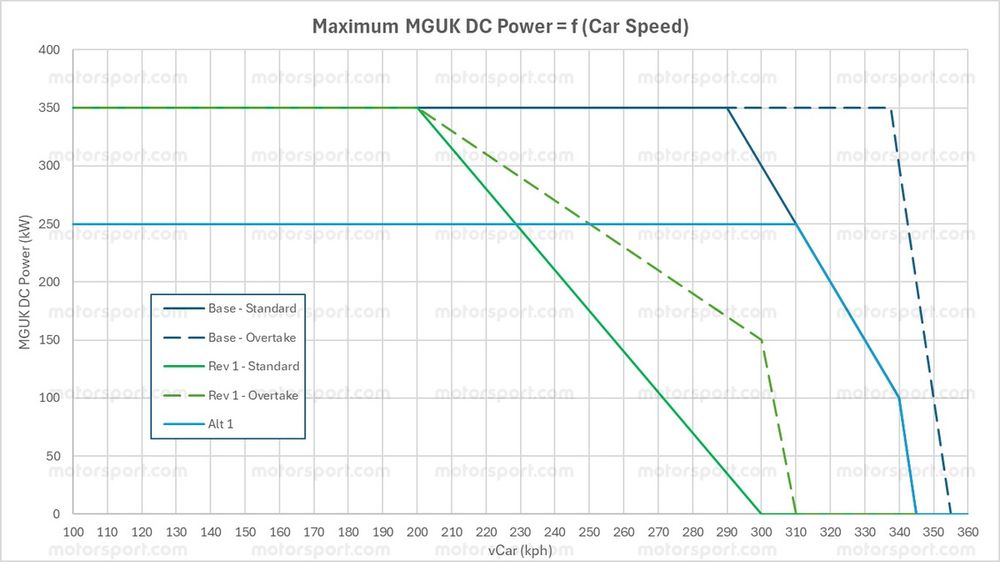
Photo by: FIA
Monaco’s track design does not impose significant energy management demands, as its many braking zones facilitate effective battery regeneration. Consequently, when in ‘overtake mode’, the MGU-K will cease providing peak power at 200 km/h, contrasting with 335 km/h, though the power reduction gradient will be less aggressive.
Theoretically, at 260 km/h, the conventional engine map generates approximately 150kW from the electric motor, whereas the overtake mode will supply almost an additional 100kW.
We want to hear from you!
Let us know what you would like to see from us in the future.
Take our survey
– The Autosport.com Team