James Allison, the technical director for Mercedes, explains that the squad’s choice to delay the finalization of their 2026 Formula 1 challenger has left them mismatched in timing compared to their rivals, leading to a back-and-forth swing in performance as in-season upgrades deliver significant pace steps.
The W17 has established itself as the benchmark car, kick-starting the campaign with a dominant double podium in Australia and going on to secure eight victories out of the initial 11 Grands Prix in this fresh F1 era. Even though Mercedes remains the clear title favorite, teams like McLaren and Ferrari have still managed to secure outright victories on raw pace during the course of 2026.
In an appearance on the team’s Nu Silver Arrows Radio Show podcast, Allison noted that the squad is currently unlocking “roughly six to seven times” more performance per week in the wind tunnel than they managed during the previous season. This highlights the contrast between extracting speed under a brand-new technical framework versus an older, highly optimized set of rules.
He also disclosed that the Brackley-based outfit chose to delay the final sign-off for the W17’s design. Usually, teams implement a “design freeze” deadline, after which the vehicle enters production and subsequent performance steps are held back for later in-season upgrades.
By pushing this freeze point further back, Mercedes squeezed their production schedules but successfully integrated early-stage upgrades directly into the launch specification. Allison admitted this strategy left absolutely no room for error if any setbacks occurred, but it enabled them to fully exploit their ongoing development trajectory.
“In terms of aerodynamics, our weekly progress rate in the wind tunnel—specifically the amount of lap time we are uncovering—is roughly six to seven times greater than our progress last year,” Allison remarked.
“We are talking about roughly half a second of performance every couple of months, which represents an incredibly rapid development curve. Because of this, we made every possible effort to debut a highly competitive package at the season opener.
“Thankfully, that proved to be a very solid initiative. However, a key element of our overall approach was a conscious internal decision on both the aerodynamics and bodywork fronts to delay the final design freeze by several weeks—longer than we ever have before. We committed to a schedule that featured practically zero margin for error.”
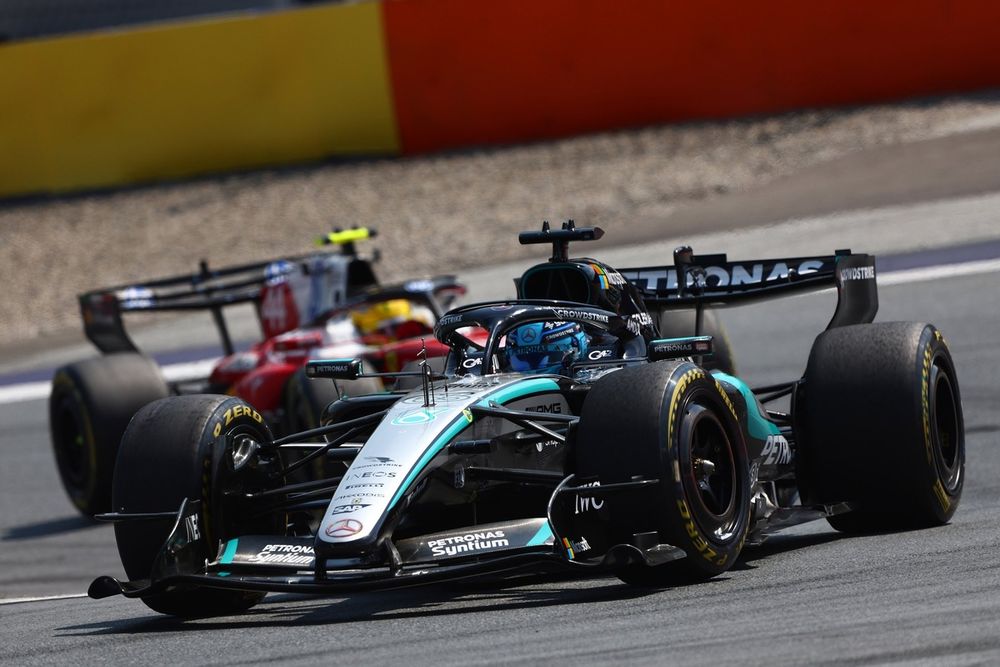
Lewis Hamilton, Ferrari, George Russell, Mercedes
Photo by: Andy Hone/ LAT Images via Getty Images
“By following that aggressive timeline, we managed to pack as much of that rapid early development curve directly into the launch car for the opening grand prix as was physically possible. We exhausted all our immediate resources to achieve this. In contrast, other competitors perhaps didn’t push their manufacturing deadlines quite so close to the limit, which meant they were able to introduce their first major upgrades much earlier.”
Allison explained that while this approach gave Mercedes a distinct advantage early on, it temporarily emptied their development pipeline. This has left them lagging “a race or two” behind their competitors in rolling out subsequent upgrades, as they had to accumulate new performance steps.
He pointed out that a half-second pace advantage can be completely neutralized once other teams introduce their own upgrade packages. Consequently, Mercedes faces a period of vulnerability while they prepare their next round of updates to reclaim their lead.
This dynamic explains the shifting competitive order at the front: Ferrari made a step forward in Barcelona with a major upgrade package, while McLaren’s introduction of a revised floor in Hungary paved the way for their maiden victory of the year.
“They locked in their base design sooner, allowing them to prepare their first performance upgrade for an earlier release. Meanwhile, we arrived at the first race with an incredibly strong car, but we had already used up all our immediate ideas,” Allison added.
“We have had to rebuild our reserves of performance, which has put us out of sync. Because we front-loaded our development, our upgrade schedule is now running a grand prix or two behind the timeline of our competitors.
“From the lap times we are analyzing, it looks like everyone is scaling the exact same development peak. The entire grid is finding about half a second of pace every two months. Therefore, being even half a step behind in the upgrade cycle means a half-second advantage, like the one we enjoyed at the start, can quickly disappear.
“A single major upgrade cycle from a rival can wipe out that gap entirely, which is certainly a tense position to be in. At the same time, we know we have significant gains still to come. It is simply a matter of timing regarding when we introduce those new components.
“Our approach now is to simply keep ourselves in the hunt and guarantee that our next major performance step successfully re-establishes the benchmark we set at the beginning of the campaign.
“We just need to navigate these challenging weekends where our rivals are rolling out all their latest updates.”

Watch: The Mid-Season Review
Share your feedback with us!
Tell us what kind of content you would like to see next.
Participate in our survey
– The Team at Autosport.com