The Formula 1 Australian Grand Prix is set to introduce a new five-second ‘pre-start’ delay, providing competitors positioned towards the rear of the grid with additional time to prepare their updated power units for the commencement of the event.
This modification to the race start procedure was outlined in the official race directors’ documentation, following successful trials conducted during the concluding week of pre-season testing in Bahrain. The change was prompted by concerns that the slower activation period of the new turbochargers could lead to difficulties when launching from the starting line.
Due to the omission of the MGU-H from the current power unit configuration, an element previously used to accelerate the turbo using stored energy, drivers discovered they required increased engine revolutions to initiate turbo operation. The absence of this system resulted in sluggish departures and exposed certain vehicles to the risk of activating anti-stall mechanisms.
Once all competitors have assumed their positions on the grid, a five-second pause will occur after the green flag is waved at the back of the grid, accompanied by a pulsating blue indicator on the starting gantry. Subsequently, the conventional start lights will function as normal. This adjustment aims to ensure that those starting from the back have ample opportunity to get their turbines rotating effectively.
While the majority of teams on the grid endorsed this decision during the simulated starts in Bahrain, Ferrari appeared perplexed by this development. Team Principal Fred Vasseur had previously asserted that this potential issue had been identified a considerable time ago, and it is understood that Ferrari had engineered a smaller turbo specifically to mitigate this.
Nevertheless, the Italian team maintained an advantage at the beginning of those practice starts, as rival teams were still working to refine their turbo activation processes.
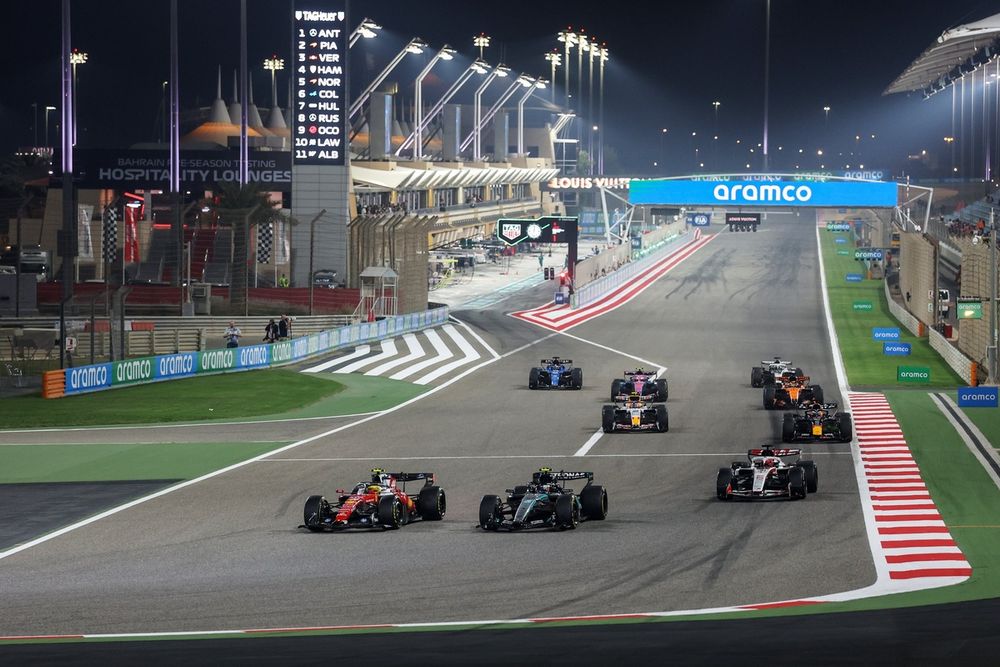
Lewis Hamilton, Ferrari, Andrea Kimi Antonelli, Mercedes, Esteban Ocon, Haas F1 Team
Photo by: Steven Tee / LAT Images via Getty Images
“With the introduction of the blue panel, the process is now somewhat more manageable,” remarked Kimi Antonelli of Mercedes, discussing the updated starting procedure.
“Nonetheless, achieving precise timing and generating the correct amount of boost at the opportune moment will remain critically important, as failure to do so could result in a significantly poor start.
“Observing Ferrari in particular, they appear to be exceptionally proficient in this aspect, making it essential for us to continue our efforts, especially since we encountered some difficulties in Bahrain.
“We’ve certainly put in a great deal of work and seen improvement, but I believe further refinement is needed to reach Ferrari’s level. However, one can never predict; perhaps we’ll achieve an outstanding start in Australia’s inaugural race on Sunday, you never know.”
Moreover, the regulation preventing the deployment of the active aerodynamics system until after the initial corner has been officially confirmed, resolving previous ambiguity regarding its potential use at the beginning of the race.
The directives also specify that a section of grass has been installed at the exit of Turn 6, intended to lessen the amount of gravel dispersed onto the track surface.
We want to hear from you!
Let us know what you would like to see from us in the future.
Take our survey
– The Autosport.com Team