The 2026 Formula 1 campaign has reached an intriguing juncture where no frontrunning team is prepared to concede that they possess the quickest machinery.
Following his runner-up finish behind Lando Norris at Zandvoort, current points leader Kimi Antonelli asserted that Mercedes has slipped from the top spot, suggesting their package might currently rank as only the third-fastest on the grid.
Conversely, Norris—who holds fourth position in the drivers’ title race with 159 points compared to Antonelli’s tally of 242—remained eager to temper expectations regarding a late-season title charge, even after securing back-to-back victories. “I lack the necessary machinery to mount a proper championship challenge,” he remarked in the wake of his triumph in the Netherlands.
For many observers, this calls to mind the famous Mandy Rice-Davies adage: “Well, they would say that, wouldn’t they?”
Nevertheless, it remains obvious that the current set of technical rules still yields contrasting vehicle traits, adding layers of complexity to the competitive order. Speaking in general terms, the McLaren MCL40 excels through high-speed turns, the Ferrari SF-26 displays strong characteristics when navigating low-speed bends, and the Mercedes W17 occupies a middle ground. Consequently, the performance hierarchy shifts dramatically depending on the specific track configuration.
Norris argues that his current package lacks the versatility to dictate terms at every remaining circuit, unlike the previous season’s McLaren, which consistently set the benchmark across various venues.
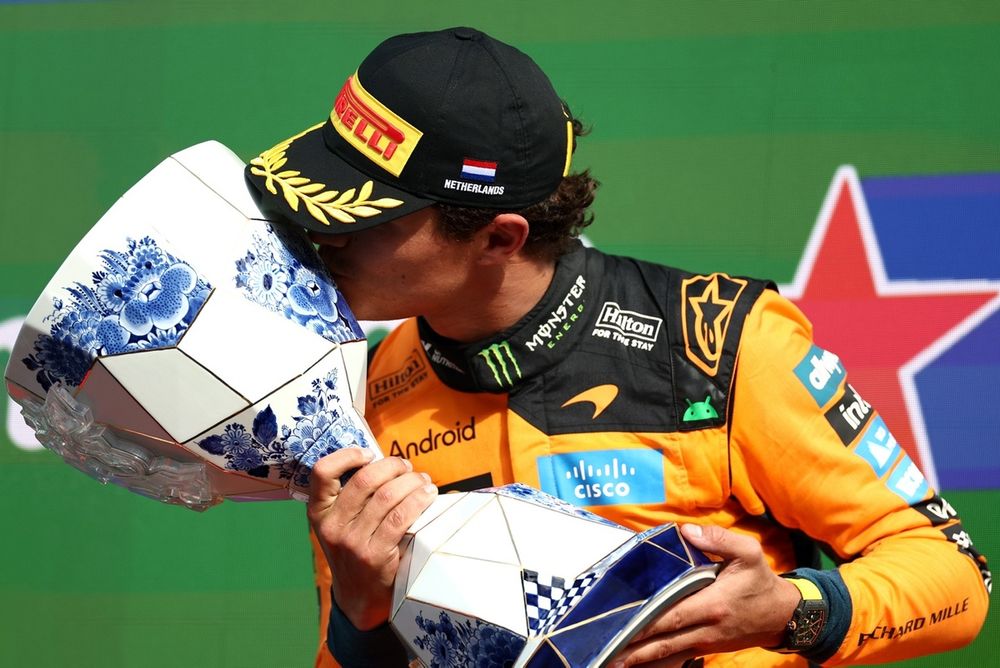
Norris minimized the weight of his Dutch GP triumph
Photo by: Alastair Staley / LAT Images via Getty Images
“Our car has distinct strengths in particular zones,” he explained. “Unlike last season, when we performed reasonably well across the board, we are now exceptionally potent in high-speed sections. Indeed, the high-speed domain is where our development team has unlocked the greatest steps forward.
“We are unmatched through rapid corners, which is undoubtedly a positive. The lap-time advantage I held over Mercedes through Turns 7 and 8 was remarkable.
“At the same time, their superiority over us in slower sections is equally massive. Because of that contrast, I cannot confidently declare that I will easily challenge for the title over the rest of the calendar. Although I have secured two consecutive pole positions and race wins, I currently do not possess the machinery required to sustain a true championship bid.
“I realize that is a bold statement, but my experience from last year taught me precisely what a car must deliver and what is required of me as a driver. I am fully aware of my current performance level and capabilities. I know exactly what characteristics I require from my package, and I can already point to upcoming venues on the calendar where we will undoubtedly face greater challenges.”
However, the dynamics at play are far more intricate than merely classifying a vehicle as fast in specific corner types. The current generation of single-seaters features a shorter wheelbase, reduced width, and a marginal weight reduction. Furthermore, chassis behavior is more tightly coupled with engine performance than in the past, largely because corner-entry velocities directly dictate energy recovery efficiency.
The choice by McLaren to adopt a shorter wheelbase, which aided their weight-saving efforts early in the year, has locked in inherent limitations regarding the maximum downforce they can extract from the underfloor aerodynamics.
Furthermore, performance fluctuates significantly depending on the chosen tire compound. During the Saturday sprint, Norris ran the medium compound but suffered from rear tire wear, allowing Ferrari’s Charles Leclerc to slip past him late in the session. In Sunday’s main event, he began on scrubbed soft tires, surrendered the lead to Antonelli off the line, and only truly found his rhythm once he switched to the hard compound.
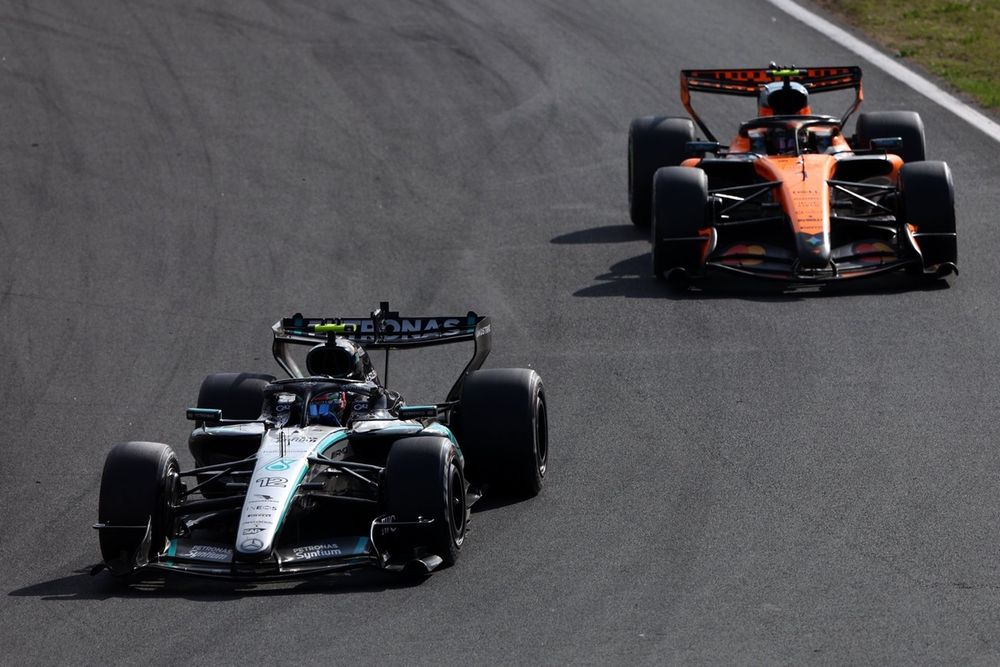
Norris applied pressure to points leader Antonelli in the closing stages of the Zandvoort event
Photo by: Andy Hone/ LAT Images via Getty Images
“Once we bolted on the hard compound,” he recalled, “we adopted a more assertive strategy for that phase of the race, which completely shifted the momentum. I finally rediscovered the balance I was looking for. My outlook transformed from feeling out of contention to believing we could pressure Antonelli into an error.
“If the car responds exactly as I desire, giving me a positive front-end feel and a predictable rear end during corner entry, I gain the confidence to anticipate how the car will behave at every turn. When those elements align, victory is well within reach.”
In terms of driving technique, Norris shares similarities with Max Verstappen, contrasting with the approach of competitors like George Russell or his stablemate Oscar Piastri. Instead of keeping braking, acceleration, and steering input as distinct, isolated steps, he prefers to overlap his brake and throttle inputs while taking a wider, shallower line into corners. This method allows him to search for the sweet spot where the front tires establish lateral traction, aiding car rotation and maintaining momentum as he heads toward the apex.
Achieving this dynamic demands not only an assertive front end but also precise feedback through the steering wheel regarding front-tire grip—a formidable task for design engineers. Because contemporary ground-effect cars depend on a stable ride height to maximize aerodynamic performance, suspension configurations are engineered to restrict pitch and squat, which unfortunately limits the tactile feedback available to the driver.
While some drivers can adapt to this lack of feel, others struggle. This prompted McLaren to introduce a modified front suspension setup featuring an adjusted kingpin angle specifically for Norris when he was searching for form early last year. With that crucial feedback restored, his capacity to vary his racing lines and manage brake-throttle overlap increases, explaining his exceptional pace on low-grip track surfaces.
Yet, despite his immense versatility under these conditions, he remains reliant on a responsive front axle, clear tactile communication, and absolute faith that the rear of the car will step out predictably when called upon.
“Our deficit areas are well-defined,” Norris summed up. “As a result, we must focus our efforts on addressing those limitations. Until those fixes are in place, the concluding stretch of this championship will remain a massive hurdle.”