Toto Wolff, the team principal for Mercedes Formula 1, has stated that his organization lacks the necessary funds to match the level of 2026 car development being carried out by Ferrari and McLaren.
In recent months, both Ferrari and McLaren have taken major strides forward by consistently introducing upgrades, which has enabled both teams to secure multiple Grand Prix victories.
On the other hand, a highly cautious approach to updates at Mercedes—with almost no major developments introduced since May’s Canadian Grand Prix—has seen the Brackley-based outfit lose its early-season competitive edge.
Addressing reporters after McLaren’s defending champion Lando Norris claimed back-to-back victories in 2026 at Zandvoort, Wolff admitted that Mercedes cannot keep pace with the development rate of its main competitors for the 2026 season.
When questioned by Autosport on whether these development choices are becoming more difficult to justify given McLaren’s swift rise, Wolff explained that Mercedes is restricted by how they have distributed their $215 million budget cap allocation.
“The financial resources to continually introduce new parts to the car simply aren’t there. As I’ve mentioned previously, we aimed to distribute our budget across the year based on projections of when upgrades would deliver the most impact to maximize our championship points. Ultimately, we are bound by our financial limits,” the Austrian team boss explained.
“This is exactly why it is a continuous development battle. When you introduce a major update, the front-running teams usually gain a minimum of two-tenths of a second, and that is the margin you fall behind by if you don’t. Consequently, this phase of the season has been far more challenging than our start to the year.”
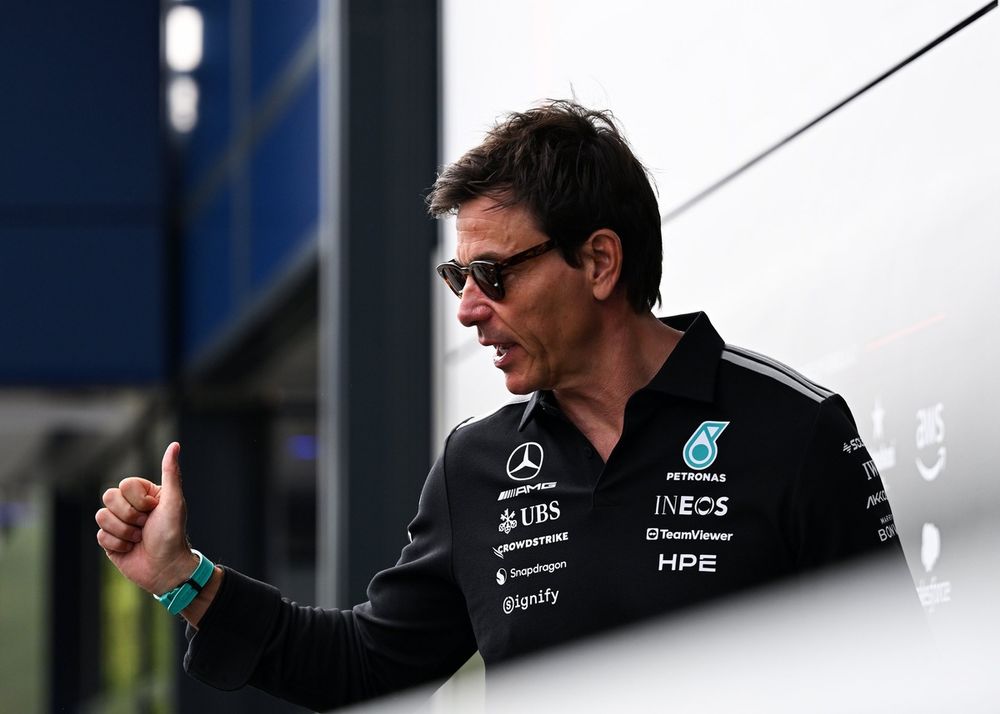
Mercedes Team Boss Toto Wolff
Image credit: Sam Bagnall / Sutton Images via Getty Images
When asked to clarify why Mercedes is facing budget cap limitations while McLaren and Ferrari continue to update their cars, he responded: “The true picture will emerge as the year concludes, showing whether they can maintain this level of component production.
“Certain competitors might have opted for an alternate approach, choosing to invest more heavily during the early and middle phases of the season rather than saving resources for the final races.”
It is anticipated that Mercedes will not introduce any major revisions to the W17 before the sport transitions back to flyaway events, which begins with the early October Grand Prix in Malaysia.
Wolff noted that their current situation would appear much brighter had Mercedes not encountered severe engine reliability problems. These failures have already stripped Kimi Antonelli and George Russell of numerous points and are set to trigger grid penalties later in the season.
“Did our early expenditure and initial development take up too much of our budget? I don’t believe so,” he continued. “It is simply a matter of the scale of our organization and our operational setup.
“In terms of performance, we produced an exceptionally fast car. However, mechanical failures cost us between 50 and 100 points, which would have provided a much healthier buffer in the standings. Aside from that, we are simply sticking to our original roadmap and managing the financial constraints we face.”
Your feedback matters to us!
Tell us about the kind of content you want to experience next.
Participate in our survey
– The Team at Autosport.com