Rafael Camara has been confirmed as a Formula 1 driver for the 2027 season, stepping in as Esteban Ocon’s successor at Haas.
This announcement means the 21-year-old Brazilian will make his F1 debut following a swift ascent through the lower-tier racing categories.
Camara secured the 2024 Formula Regional European Championship and clinched the 2025 Formula 3 championship, and he is currently leading the Formula 2 standings by seven points.
He is, however, still a budding talent compared to Ocon, who has faced challenges since he joined Haas at the beginning of 2025.
So, has the American team made a sound decision? Our analysts weigh in on the matter.
Camara’s raw speed makes him an excellent selection
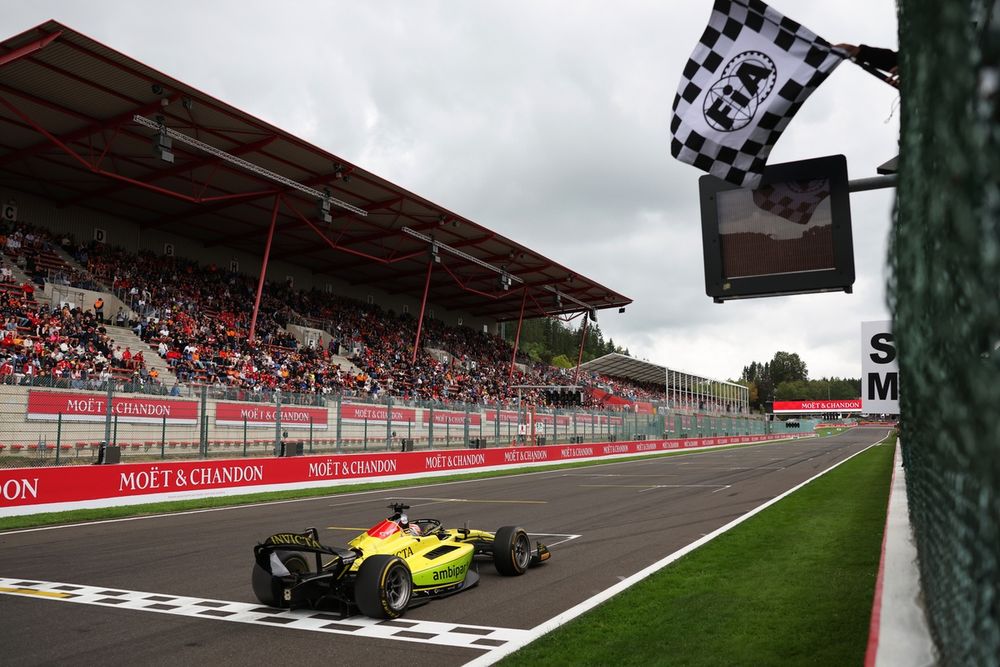
Rafael Camara, Invicta Racing
Photo by: Dom Gibbons / Formula 1 via Getty Images
The adage prevails: while you can train a fast driver to be dependable, you can’t turn a dependable driver into a fast one.
Camara stands out among the quickest drivers from the last decade in junior categories; his qualifying statistics are impressive. He notched seven pole positions, more than any other driver, en route to the 2024 Formula Regional European Championship title. For the 2025 F3 season, he achieved five poles out of nine, an unparalleled achievement in contemporary racing. To find a similar accomplishment, one must go back to Luca Ghiotto’s matching performance in the 2015 GP3 season, where he narrowly lost the championship to Ocon.
Fast forward over a decade, and Ocon is now being ousted from Haas in favor of Camara. Are Ocon’s results this season a true reflection of his capabilities? Likely not, as the VF-26 has often shown inconsistency issues that have negatively impacted his performance. This, in turn, may have affected team morale as frustrations mounted, thus, changing drivers seems logical—particularly with talent like Camara ready to step in.
The Brazilian possesses it all: support from Haas’s partner Ferrari—similar to his anticipated future teammate Oliver Bearman—genuine speed, and the potential to claim consecutive titles in FREC, F3, and F2. Currently, Camara leads the standings in F1’s supportive series, having secured five poles out of 13. No other driver has achieved more than two pole positions.
There have certainly been missteps, such as his lock-up that led to retirement while battling title contender Nikola Tsolov for a win in Monaco; nonetheless, Camara has consistently gained points and secured impressive feature race victories.
While Haas may miss Ocon’s experience, Bearman is positioned to evolve into a leadership role, hence this decision seems prudent for future readiness.
– Ben Vinel
Why replace a grand prix victor with a novice?
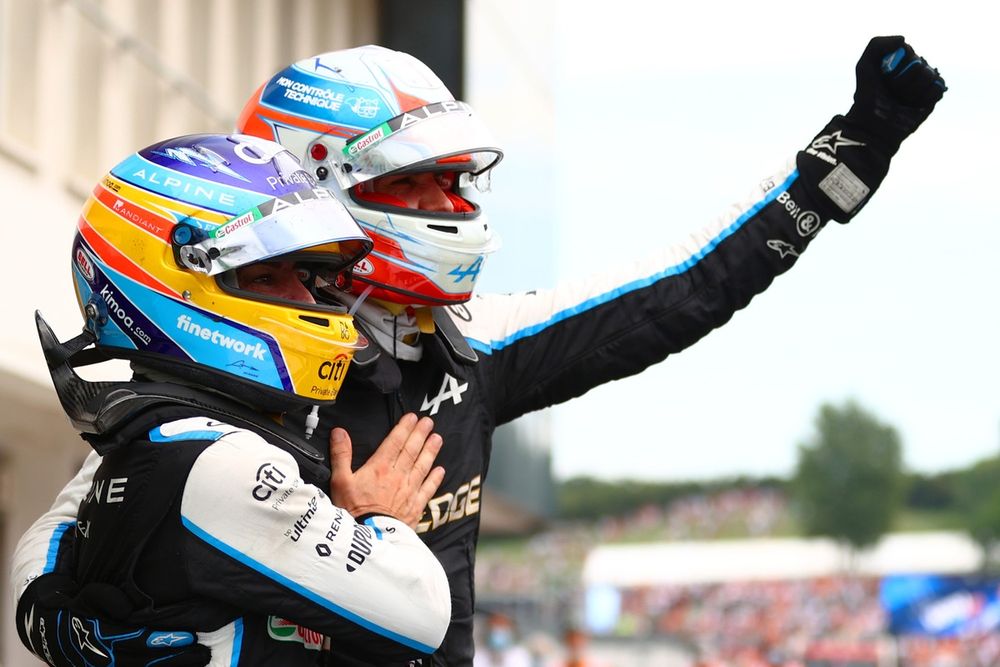
Ocon after winning the 2021 Hungarian GP
Photo by: Dan Istitene / Getty Images
Ocon has been candid about his circumstances: he’s articulated that he doesn’t merit this situation, to phrase it accurately. I find it difficult to contest his statement.
Despite the fact that statistics often paint a clear picture, and Ocon, being the more seasoned racer and arguably the team principal, has accumulated fewer points thus far than Bearman.
Is this truly reflective of his underperformance?
Ayao Komatsu has acknowledged existing inconsistencies with the vehicle, and according to Ocon, there have only been a few races where he could genuinely compete. The most recent events indicate that even if he isn’t outperforming Bearman, he’s certainly matching his performance.
Throughout its history, Haas has heavily relied on drivers with extensive experience. Figures like Romain Grosjean and Kevin Magnussen were instrumental in transforming it into a reputable team, while the organization has also had disastrous experiences with rookies in prior instances. The earlier decision involving Mick Schumacher and Nikita Mazepin stemmed from a financial necessity, owing to the backing both provided. But is it truly necessary for Haas to choose a rookie driver at this juncture? There is little proof to suggest such a need.
It seems that Camara has been selected by Haas primarily for sporting reasons, yet I struggle to see how he could currently outperform a proven race victor. Unless there’s excessive pressure from Ferrari to recruit another member from its Academy, I don’t foresee Camara achieving more points for the team initially than Ocon, considering the latter’s extensive experience.
When the car operates effectively, Ocon remains speedy and reliable. Why, then, instigate this shift? Particularly if the replacement is a driver who may be recalled by Ferrari whenever necessary.
How is it feasible to build a future with competitors who are essentially on loan from a larger team? I previously believed that the combination of Ocon and Bearman made total sense because Ocon was a driver associated with the team. Now, Haas appears more to be evolving into a Ferrari junior team rather than remaining an independent entity.
Of course, this becomes moot if Komatsu has identified something extraordinary in Camara during the TPC testing sessions—and considering Bearman’s development, one might argue that Ayao has good judgment.
Yet, there lingers a sentiment that Ocon has been unfairly treated by the team, which seems to have utilized its underperforming vehicle as justification for his removal.
– Oleg Karpov
This presents an opportunity for Haas to secure a generational talent
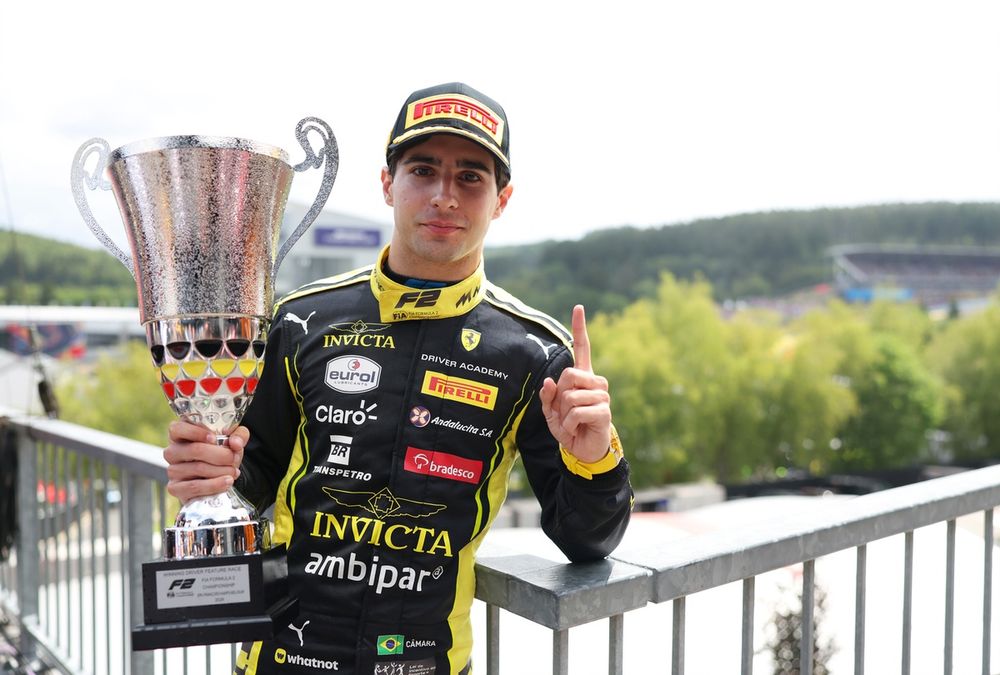
Rafael Camara, Invicta Racing
Photo by: Dom Gibbons / Formula 1 via Getty Images
In recent rounds, it has been difficult not to feel sympathy for Ocon, as he has made remarkable statements in a clear effort to maintain his position on the grid. Would he have articulated such points if he weren’t under pressure? Probably not. This was evidently a strategy on his part to highlight his previous achievements, acknowledging that the stakes are high.
However, a significant portion of what he asserted holds true. Ocon successfully concluded a commendable junior career by winning GP3 and even surpassed Max Verstappen in European F3.
His outstanding debut full season in 2017, where he garnered points in nearly every race for Force India, remains notable—as does his near career-defining opportunity with Mercedes during its peak years. Additionally, his victory at Hungary in 2021 and the fact that he’s one of only two drivers, alongside Jenson Button, to outscore Fernando Alonso in a season while being teammates (92 to 81 in 2022) should not be overlooked.
It is hoped that Ocon’s legacy will be shaped by these achievements rather than his two seasons at Haas. In a similar vein, Daniel Ricciardo is likely to be remembered for everything except his downward trajectory in recent years.
Yet a prevailing opinion remains: the time has come for Ocon to move on. Although recent results indicate an improvement, can we attribute that to the 30-year-old’s understanding that his job is on the line? Haas isn’t likely to achieve significant gains with the Frenchman at the helm, yet it just might progress with an exciting rookie like Camara.
While age and experience are frequently cited, consider that the anticipated 2026 champion—Kimi Antonelli—began the season as a teenager. Thus, is that still a decisive factor in today’s era? Camara, being the same age as Bearman, exhibits a remarkable junior record.
If he triumphs in F2, he will join the ranks of Charles Leclerc, George Russell, Oscar Piastri, and fellow Brazilian Gabriel Bortoleto as champions in F2 and F3 as rookies. Camara will also be the only driver to earn back-to-back wins in those categories plus FREC.
These statistics point to a potential frontrunner for the future, and when considering the 21-year-old’s speed—as noted by Ben—he’s already at an F1 caliber. There is every reason to believe he will be contending for victories and titles in a decade. An opportunity for Haas to sign such a talent may not present itself again, making this a chance that should not be overlooked, and it is commendable that they are acting upon it.
– Ed Hardy
We want to hear from you!
Let us know what you would like to see from us in the future.
Take our survey
– The Autosport.com Team