The Formula 1 Commission has officially approved the recommended adjustments to trim race distances by 15 kilometers starting in 2027, aligning with the upcoming modifications to the power units.
At Monday’s F1 Commission gathering in London, representatives reached an agreement to shorten the typical grand prix distance from 305km down to 290km. Subject to final authorization by the FIA’s World Motor Sport Council, this step aims to curb the expenses of altering chassis designs to accommodate the modified power profiles of the various engine parts.
An earlier ruling for 2027 established that the internal combustion engine’s output would be boosted while scaling back the electrical system’s contribution. This change is designed to realign the overall formula and minimize excessive energy harvesting and power clipping during grand prix events.
Consequently, the ICE output will rise to 420kW, whereas the top capacity of the MGU-K will be limited to 300kW—with the exception of overtake mode, which is staying at 350kW. To support this boost in performance, the engine’s fuel flow rate has been raised by five percent.
Instead of expanding the size of the fuel cells to handle the faster fuel consumption, the FIA and FOM opted to shorten the actual race lengths. This approach mitigates the danger of competitors running out of fuel before the checkered flag, resulting in a reduction of roughly three laps at the majority of tracks.
Whether this reduced race length will persist into 2028 remains uncertain, as the engine regulations are set for another update then. For 2028, ICE performance is scheduled to climb to 450kW, backed by a total fuel flow surge of 13% to target a 60/40 balance between thermal and electrical power, which will ultimately require bigger fuel tanks.
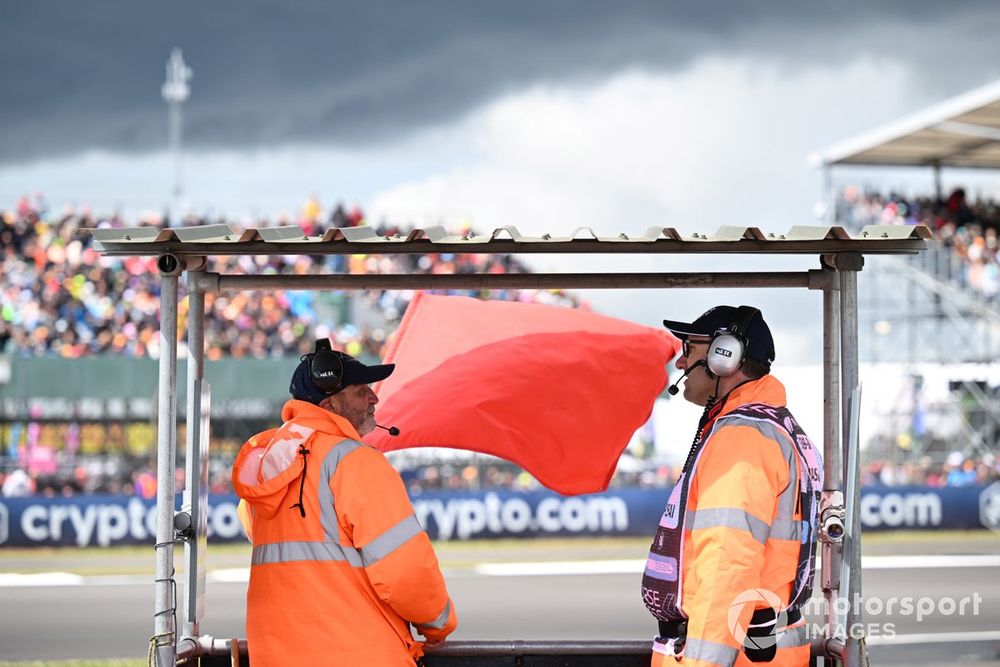
Track marshals displaying the red flag
Image credit: Simon Galloway / Motorsport Images
Additional revisions have been submitted by the F1 Commission for WMSC validation, notably regarding the timing regulations for interrupted grand prix races. While the active two-hour driving limit is preserved, current rules restrict races affected by red flags to a total three-hour window.
This three-hour limit is set to be scrapped, introducing a firm cutoff time tailored to available daylight for races delayed by weather or incidents. The FIA explained that “these adjustments are intended to maximize the opportunity for fans to watch a complete race despite any interruptions.”
The official announcement also indicated that race directors will gain increased authority to prolong practice sessions when prolonged red-flag suspensions occur. This follows the FP3 session at the Spanish Grand Prix, which had its track time slashed by roughly half an hour due to separate crashes involving Lewis Hamilton and Ollie Bearman.
Hamilton crashed into the barriers at Turn 22, causing a 25-minute delay for track repairs, while Bearman’s accident near the end of the hour cut the remaining running time by another five minutes.
Additionally, the freeze on gearbox development has been lifted for 2027, allowing teams to continue refining their transmission units during the upcoming year. The update also hints at further slight technical adjustments for next season, alongside unrevealed financial and sporting rule tweaks for the current campaign.
Your feedback matters to us!
Share your thoughts on what we should cover going forward.
Participate in our survey
– The Autosport.com Editorial Team