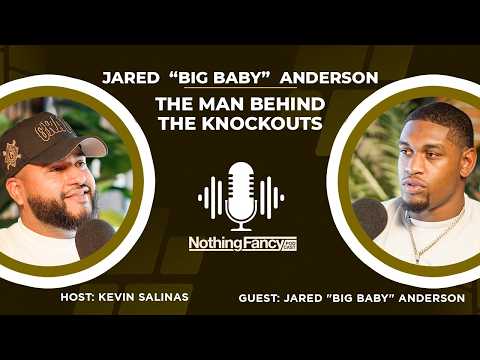

“My perspective hasn’t changed since I was fifteen years old. My goal is to secure my earnings and make my exit. Most people fail to realize how exhausting it is to train constantly day in and day out, only to receive blows to the head for a career,” Anderson shared with Nothing Fancy. “Indeed, this is a return. I intend to step back into the ring, and without a doubt, it is motivated by financial gain, the same as everyone else in this business. No one is putting their body on the line without getting paid.”
The issue lies in the fact that Anderson has already liquidated the market appeal that Top Rank spent close to half a decade building up. His career trajectory was carefully managed, resembling how Queensberry matches Moses Itauma—utilizing carefully selected opponents to construct the reputation of an upcoming heavyweight titan before subjecting him to the elite threats of the weight class.
He appeared spectacular when stopping handpicked opponents designed to highlight his strengths. However, red flags began to emerge during his July 2023 encounter when Charles Martin managed to stagger him. Subsequently, in April 2024, Ryad Merhy spent ten rounds fighting entirely defensively, exposing Anderson’s inability to deploy a diverse enough offensive arsenal to penetrate his guard.
These vulnerabilities were readily apparent on tape. Anderson frequently retreated in a straight line with his chin exposed in the air, offering Martin an easy target for his left hand. Bakole later exploited this exact defensive deficiency, landing punishing uppercuts and powerful combinations. While Anderson seemed formidable when pressing forward against accommodating opponents, his lack of inside game was exposed when a more powerful heavyweight pushed him onto the back foot.
Instead of focusing on further growth, Anderson opted for a high-risk showdown with Bakole on the Riyadh Season event organized by Turki Alalshikh in Los Angeles. Despite resistance from both his management team and Top Rank, Anderson insisted on taking the fight to secure the payday, driven by financial strains following his mother breaking her ankle.
“It was entirely about the financial compensation,” Anderson admitted.
The Downfall of Top Rank’s Meticulous Matchmaking
During that period, Anderson was backed by massive promotional momentum. ESPN positioned him as their eighth-ranked heavyweight, Turki Alalshikh appointed him as an ambassador for Riyadh Season, and he was widely marketed as the premier prospect to take over as the next great American heavyweight champion.
The initial blueprint called for Anderson to go up against a declining Deontay Wilder. However, after Zhilei Zhang knocked Wilder out, Bakole was brought in as the replacement. Rather than reverting to the more protected development path laid out by Top Rank, Anderson decided to pursue the immediate lucrative payday.
Bakole shattered those plans within five rounds. Anderson found himself on the canvas once in the opening round and twice more in the fifth before the referee halted the bout. With that single defeat, his high ranking, fan appeal, and mystique evaporated entirely.
This devastating loss also deprived the American boxing scene of the premier heavyweight draw that Top Rank had envisioned centering their future around. With Wilder’s career winding down, Anderson had been primed to step in as the top American figure in the division. The stoppage by Bakole obliterated those plans before Anderson could establish the massive fanbase or secure the landmark victory required to weather such a setback.
Well prior to stepping inside the squared circle, Anderson was fully aware of the risk he faced. When questioned about when the possibility of defeat first crossed his mind, he revealed, “Two months ahead of the fight.” Furthermore, he explained that his eccentric pre-fight dancing served as a way to cope with and manage his anxiety.
Following the loss, there was no systematic effort to rebuild his career. Anderson made his return half a year later, laboring through ten rounds to secure a decision victory against Marios Kollias in February 2025. Since that performance, he has remained out of the ring.
The Illusion of a Final Big Payday
In less than two years, Anderson envisions himself spending his days at home with his daughter, staying connected to the sport of boxing strictly in a non-competitive role. He expresses zero desire to endure head trauma long enough to risk slurred speech or the kind of cognitive deterioration often observed in veteran pugilists.
“Who actually enjoys getting hit in the head constantly? No one wants that. It’s simply not intelligent to subject yourself to that,” Anderson remarked. “I don’t have to spend my days taking punches. Just because I possess a talent for the sport doesn’t mean I should desire to walk around with bruised eyes, or end up speaking incoherently with a speech impediment.”
While safeguarding his well-being is logical, expecting the boxing world to grant him another massive, life-altering purse before his departure seems highly improbable.
To resurrect his market value, he needs significant victories. However, his outings against Martin, Merhy, Bakole, and Kollias highlighted that his defensive skills and offensive versatility fall short of the elite heavyweight class. Going head-to-head with a top-ranked contender could easily result in another devastating defeat.
Consequently, Anderson finds himself in a difficult position, caught between financial desires and matchmaking realities. Opting for low-risk opponents might guarantee victories, but those matchups won’t yield the kind of money required to fund his early retirement. On the other hand, the high-profile fighters who can command lucrative purses are precisely the opponents most equipped to inflict serious physical damage upon him.
Top Rank had mapped out a strategic pathway designed to eventually secure Anderson championship-level revenue. He chose to throw that long-term plan aside in favor of a single lucrative Riyadh Season payday against Bakole. Two years down the road, his star has dimmed, his ranking has plummeted, and he is contemplating retirement without having amassed the generational wealth he once assumed the sport would deliver to him.