Andrew Shovlin, the trackside engineering director at Mercedes, described the squad’s performance in the high-speed bends of Zandvoort as “rubbish” and is searching for explanations regarding the lack of consistency across stints and drivers during the Formula 1 Dutch Grand Prix.
Following a promising beginning to the event at Zandvoort, where George Russell claimed pole position and won the sprint race, Mercedes fell back behind Lando Norris of McLaren, who went on to capture pole and the grand prix win.
Although Mercedes managed a 2-3 finish in both qualifying and the main event, with Kimi Antonelli finishing ahead of teammate Russell to increase his advantage in the championship to 59 points, the squad struggled to comprehend why their initial speed faded over the weekend compared to their primary rivals.
“There are several performance aspects we need to investigate,” Shovlin remarked during an appearance on Mercedes’ Nu Silver Arrows Radio Show. “We’ll be focusing on that in the coming days to see what findings we can uncover.
“However, we were quite poor in certain turns, particularly the section involving [Turns] 7, 8, and 9. This was evident in the high-speed curves. It also placed a heavy burden on the left-side tires. We do not yet completely grasp the reason behind this.
“We have a few theories, but this isn’t an issue we have encountered previously this season. And there are numerous tracks featuring sequential corners looping in the same direction.
“Our speed was lacking in the quickest of those bends, and the difficulties seemed to escalate as the race progressed. Meanwhile, our performance in all other turns appeared quite robust.”
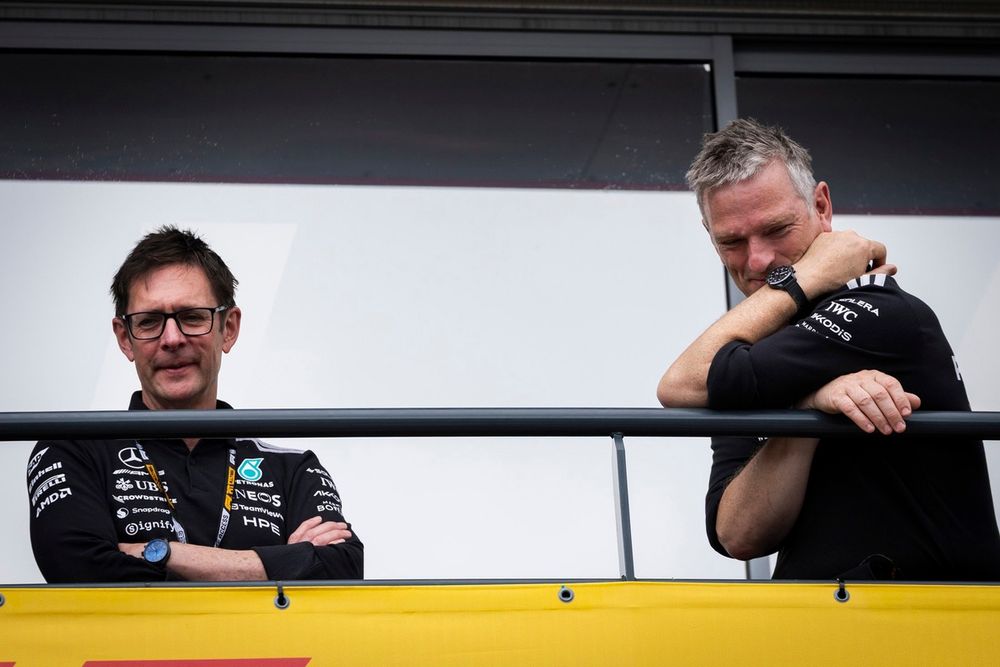
Mercedes trackside experts James Allison and Andrew Shovlin
Photo by: Sam Bloxham / LAT Images via Getty Images
Compounding the team’s perplexity was the fact that very few setup adjustments were made to the vehicles between the sprint and the main race, or even during the Grand Prix itself. Though Shovlin acknowledges that some performance variation is normal depending on tire compound and wear, the fact that both drivers encountered issues at distinct moments during the grand prix left Mercedes puzzled over the root cause.
“The car remained unaltered. Naturally, we utilized different tire compounds at various points in the race. Nevertheless, we still need to analyze this further,” he explained.
“George’s initial run was somewhat disappointing in comparison to his subsequent stints. On the other hand, Kimi had a strong opening stint, but his performance slipped in the second, declined further in the third, before recovering slightly later on. We weren’t adjusting electronic configurations or modifying wing flap angles. Yet, for him, the vehicle’s balance shifted significantly from one stint to the next.
“Typically, our drivers give comparable feedback regarding the car after a race. This time, however, their feelings on the balance—and likely the reality of the vehicle dynamics—differed, with George experiencing more understeer while Kimi dealt with oversteer. When analyzing their setups, we cannot yet explain why such a stark contrast occurred.”
“Nonetheless, walking away with a solid points haul during a weekend where our outright speed was lacking is highly positive. Working from the pit wall and making rapid tactical calls was actually quite exciting. The entire team embraced the challenge and performed well. Considering our overall situation, it was certainly a successful outcome.
“Even so, we have some serious analytical work ahead of us over the coming days.”
As noted by Shovlin, the Brackley-based squad still secured their second-largest points haul of the current campaign, bringing home 46 points—surpassed only by the 55 points claimed during the Chinese Grand Prix—although both events featured the sprint format, which provides additional scoring opportunities.