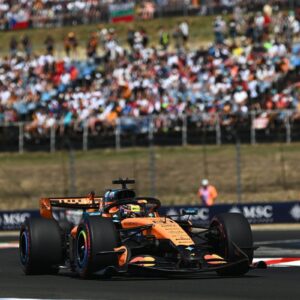
George Russell’s expensive withdrawal from the Canadian Grand Prix, which put him 43 points behind, signaled a significant challenge he’d face from Andrea Kimi Antonelli this season. His subsequent fifth qualifying loss to the impressive Italian in Monaco further emphasized that this issue isn’t temporary.
Russell commenced the 2026 Formula 1 season robustly, securing a dominant win in Melbourne, yet a sequence of setbacks, including ill-timed safety cars and mechanical failures, swiftly transferred the championship advantage to Antonelli.
However, setting aside Russell’s poor fortune in China, Japan, and Canada, a similarly – or even more – concerning pattern has become apparent in recent competitions. On tracks with lower energy demands, where heating the tires is crucial, Russell’s fluid driving method seems disadvantageous with the 2026 vehicle, whereas Antonelli’s more assertive steering input naturally places him in the optimal zone to maximize the W17’s performance.
This discrepancy first materialized in Miami, with Russell trailing Antonelli by four tenths in both sprint and grand prix qualification. Russell initially attributed this shortfall to the Miami Autodrome being a challenging venue because of its slick surface. Yet, in the subsequent two low-energy tracks, Montreal and Monte Carlo, which feature numerous low-speed turns but limited high-speed areas for lateral tire load, an identical situation unfolded.
During the Canadian event, Russell nonetheless managed to edge out Antonelli in qualifying, albeit by a slim margin, confessing he felt “lost until the very last lap of Q3” in both sessions and somehow conjured a “remarkable” lap.
Nevertheless, on Monaco’s constricted roads, Russell suffered a clear defeat, as Antonelli surged to pole position while Russell could only secure sixth place, four tenths behind.
“Honestly, I’m not entirely sure what’s occurring,” a troubled Russell commented. “There’s definitely an aspect of my driving style that isn’t benefiting the car right now.”
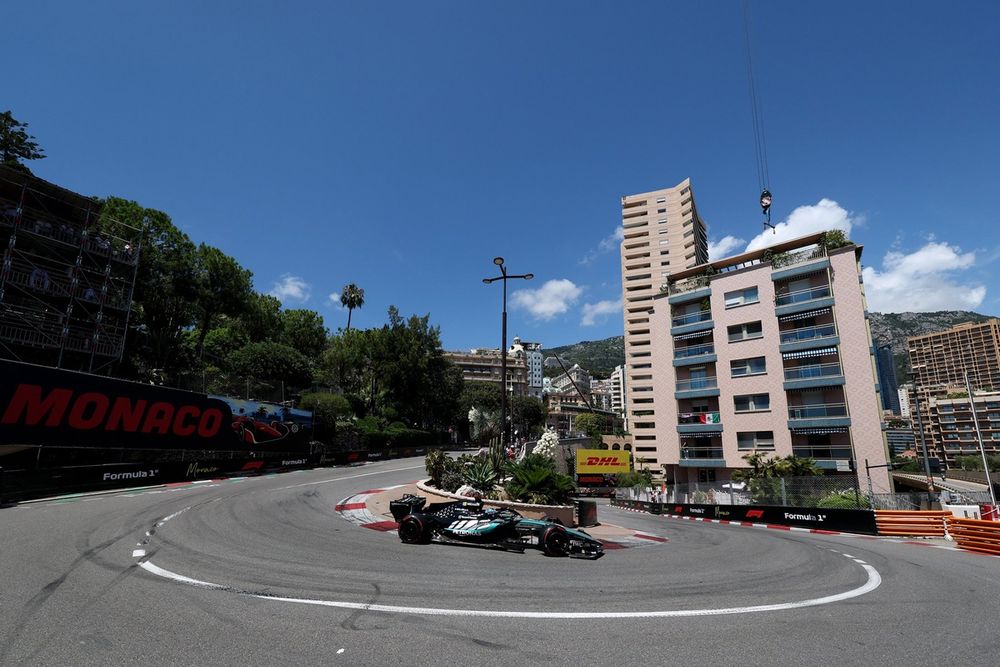
George Russell, Mercedes
Photo by: Sam Bloxham / LAT Images via Getty Images
In Monaco, it became apparent that Russell encountered difficulties in bringing his tires to optimal temperature, a problem shared by many competitors. Antonelli, however, appeared more adept at subtly guiding the tires into their ideal performance range without needing significant adaptations. Most of Russell’s four-tenth disadvantage originated in the second and third sectors, especially around the Nouvelle Chicane.
Acknowledging a discrepancy in telemetry data is distinct from comprehending how to resolve it. Russell was “perplexed” after Saturday in Monaco, prompting his team to explore adjustments to his driving during out-laps and investigate other setup modifications to alleviate the problem on comparable low-speed tracks.
“Evidently, there’s a divergence in our driving approaches, a factor present last year too,” Russell explained further. “It suited me admirably last season, and it’s unmistakably favoring him perfectly this year, yet it doesn’t explain my strong performance early in the season versus my current struggles.”
“Therefore, we must investigate the reason. The data shows it clearly. Our differing driving methods have a profound effect on the tires. He’s simply bringing the tires to a better operational state than I am. He achieves a superior balance throughout a lap, and speed comes more readily to him. I can’t pinpoint why.”
This particular problem is unlikely to resurface at the upcoming Barcelona-Catalunya Grand Prix, given its extended, challenging corners. This Spanish race will serve as an excellent test to determine if the driving style hypothesis is an isolated concern or if additional elements are contributing.
Antonelli remains unfazed despite his most significant challenge thus far
The initial pattern would not pose such a grave predicament if Russell were partnered with a novice teammate still adjusting to F1. However, the 2026 iteration of Kimi Antonelli bears no resemblance to his previous self, and the second alarming trend undermining Russell’s championship aspirations is the 19-year-old’s unwavering enthusiasm in facing every challenge F1 presents to his less seasoned teammate.
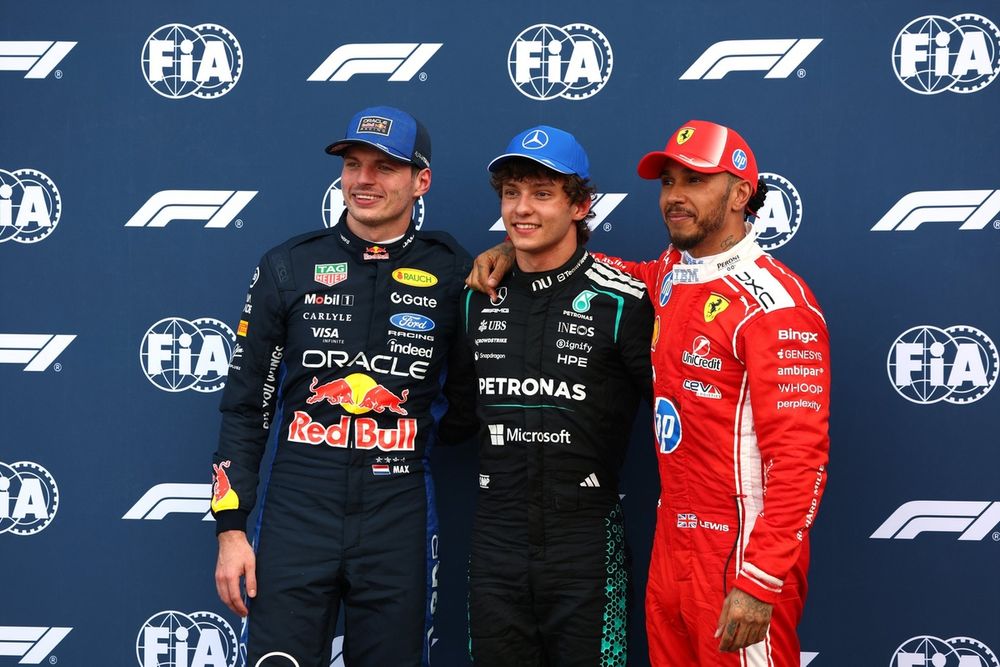
Lewis Hamilton, Ferrari, Max Verstappen, Red Bull Racing, Andrea Kimi Antonelli, Mercedes
Photo by: Sam Bloxham / LAT Images via Getty Images
With peak confidence, and mirroring Lewis Hamilton’s earlier experience, the driver from Bologna has formed an effective partnership with seasoned race engineer Peter Bonnington.
“This ranks among the most, if not the most, demanding qualifying sessions of the season, requiring immense exertion, even during practice, as you continuously strive to approach the absolute limit,” Antonelli stated moments after exiting his Mercedes, with adrenaline still surging.
“Subsequently, the challenge is to gain those final two tenths; it’s difficult as the barriers feel closer, and building confidence isn’t straightforward. However, to be frank, I felt excellent this morning, and I’m pleased we completed the task today. It was one of those exceptional laps, a ‘magic lap’ as we call it.”
As each race weekend unfolds, Mercedes’ choice to allow Antonelli to overcome initial rookie difficulties during a challenging 2025 inaugural season appears increasingly justified. Coupled with his inherent pace, his capacity to assimilate knowledge and learn from errors has seemingly transformed him into a formidable rival very quickly.
Is Russell’s challenge fleeting and limited to certain tracks, or has he finally encountered his equal in Antonelli? With the rapid succession of European races, featuring six events across eight weekends, the resolution will become evident quite soon.