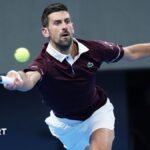
In the documentary, archival TV footage features a youthful Djokovic being questioned about his feelings toward tennis, which he describes as a “responsibility.”
“My ultimate objective in tennis is to be a champion,” he declares.
From his tactical approach to his on-court demeanor, Djokovic’s career has been profoundly molded by his early upbringing in a manner that very few of his peers could ever comprehend.
Having spent his early years in Belgrade, Djokovic was just a small child when Nato launched airstrikes against the Serbian capital from March to June in 1999.
He remembers fleeing his apartment block, which lacked a protective basement, to seek refuge in a different building. He fell while running, and his family pressed on without realizing he had fallen behind. Looking back toward his home, Djokovic witnessed an aircraft discharge two explosives onto a neighboring medical center.
“For several years, we spent almost every single day standing in queues just to get basic provisions like bread and milk,” Djokovic recounted during an interview with BBC 5 Live this past July.
“Those were pivotal times in my life, and I view them as foundational stones that helped shape both my athletic career and my personal character.
“I harbor no anger or bitterness. On the contrary, I feel nothing but thankfulness and appreciation. I believe that everything occurs for a specific purpose.”
Emerging within a costly and frequently exclusive discipline, a young Djokovic found himself as an underdog. He reflects on how his father resorted to securing loans from “shady individuals” to bankroll his initial training and development.
Upon making his major breakthrough, he shattered the duopoly of Roger Federer and Rafael Nadal that had thoroughly captivated tennis enthusiasts. Displaying far more raw emotion and vocal intensity on the court than his rivals, he did not immediately win over the hearts of all spectators.
“I was forced to bottle up a great deal of feelings, which eventually found an outlet when I was playing matches,” he explained to BBC 5 Live.
“The tennis court was the place where I felt secure and at ease. It was my sanctuary.
“Tennis goes far beyond mere sport and competition. It has been the crucible that defined my identity as an individual.”