Ferrari team principal Fred Vasseur has explained the circumstances that triggered Lewis Hamilton’s frustrated radio messages during a challenging Dutch Grand Prix weekend for the Italian squad.
For the second consecutive grand prix, the Scuderia missed out on a podium placement, with Hamilton crossing the line in fourth and his teammate Charles Leclerc securing fifth—the exact opposite of their results in Budapest—highlighting the critical turning points for the team during the 72-lap race on Sunday.
The initial incident took place around the midpoint of the race, shortly after Hamilton moved past McLaren’s Oscar Piastri for fifth place and began gaining on a struggling Leclerc. Given the narrow layout of the Zandvoort circuit, the seven-time world champion struggled to make a pass and requested team orders to bypass his teammate. Since no such instruction was given, Lando Norris, along with the Mercedes pair of Kimi Antonelli and George Russell, managed to pull further away in the distance.
“Excellent job of losing time, everyone, well done!” muttered a sarcastic Hamilton, who finally claimed fourth place when Leclerc came in for his second tire change on lap 43, which was one lap later than originally planned.
It was widely anticipated that the British driver would pit for a new set of rubber soon after, as his immediate rivals did, but the team decided to prolong Hamilton’s stint significantly, allowing him to temporarily inherit the race lead.
However, Norris and Antonelli quickly caught up on their fresher tires, and by the 53rd lap, the trio was separated by less than a second. “Am I being used to test things out here?” Hamilton questioned over the radio, finding himself defenseless as both the McLaren and the Mercedes cars slipped past him on laps 54 and 55.
The veteran driver remained uninformed about the reasoning behind his extended 30-lap second stint, and he had to wait for a virtual safety car on lap 55—triggered by Esteban Ocon—to finally swap his worn hard compound tires for a new set of softs.
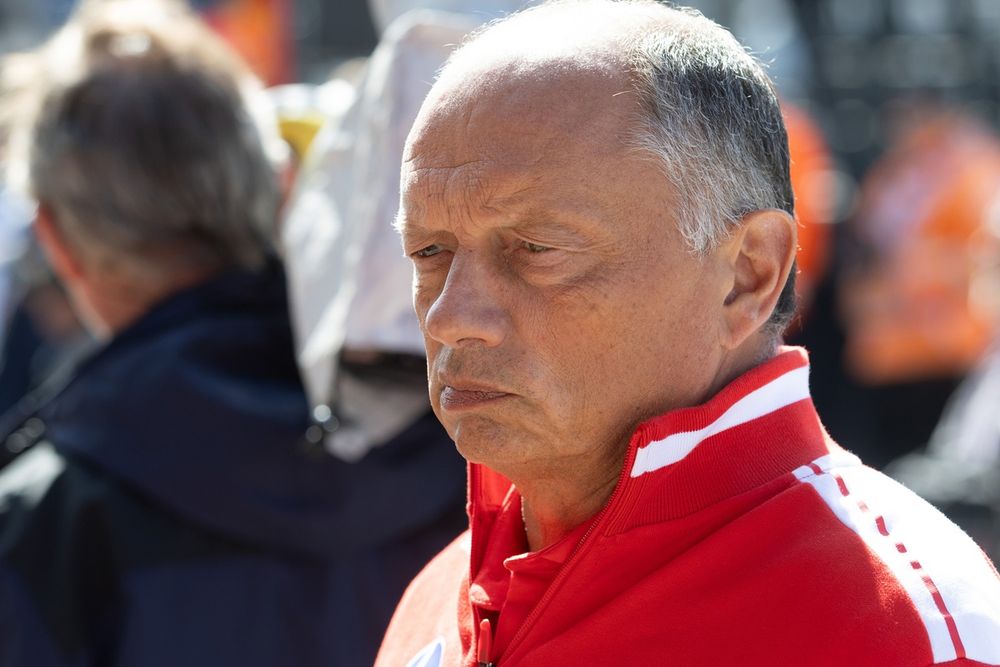
Frédéric Vasseur
Photo credit: Eric Le Galliot
Vasseur explained that they chose not to share the strategy with Hamilton at that moment to avoid tipping off their rivals, adding that keeping him out on track was, in his view, the correct decision.
He noted that Leclerc was scheduled to make a pit stop, but extending it by a single lap caused some misunderstandings. However, he expressed no concern, stating that the situation would be clarified during the post-race debrief.
According to Vasseur, Leclerc experienced some frustration regarding the tire compounds, a confusion he felt was shared by many, pointing out that Norris initiated the race on mediums before switching to soft tires.
He mentioned that the performance gap among the three tire compounds was minimal that day, making it tricky to establish a definitive strategy. He added that adapting or altering plans based on rival behavior is sometimes necessary, even if it proves frustrating for the drivers.
Naturally, these events dominated Hamilton’s post-race press duties, where he urged the team to deliver “sharper execution.” He pointed to his previous team, Mercedes, as an example of effective management, referencing the swift team instructions that saw Russell yield second place to Antonelli on lap 65, after the points leader pitted for softs during the VSC period while Russell remained on the hard compound.
Russell had initially warned his race engineer, Marcus Dudley, that they had compromised a double podium finish as Hamilton closed the gap on him, but the Mercedes racer ultimately secured third and acknowledged after the race that the position exchange was the right move.
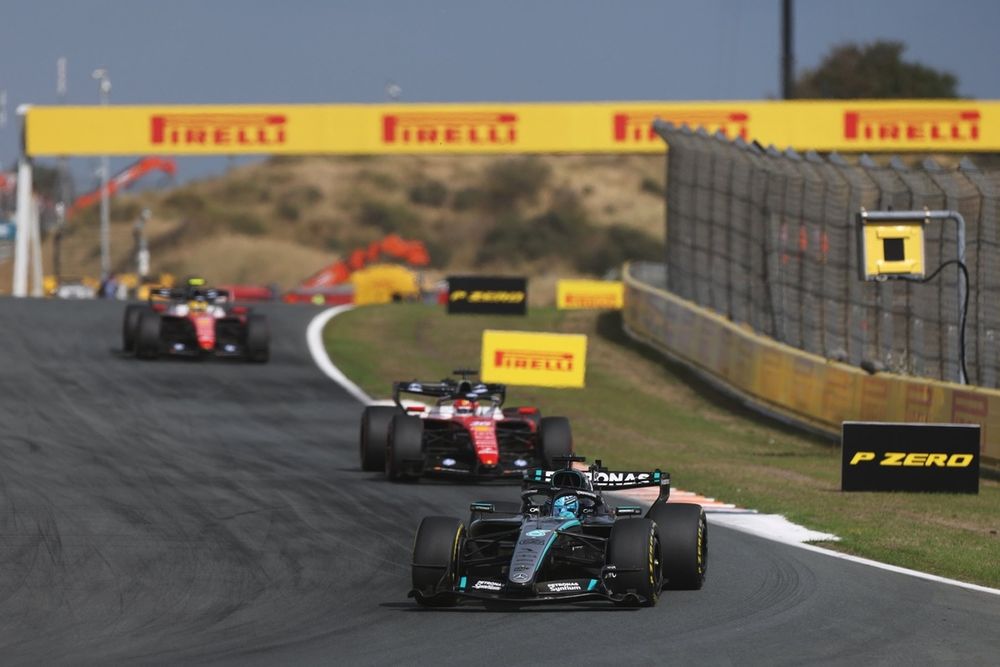
Charles Leclerc of Ferrari alongside George Russell of Mercedes
Photo credit: Simon Galloway / LAT Images via Getty Images
Hamilton believed that without the earlier complications involving Leclerc, he would have stood a much stronger chance of clinching a podium finish in the closing stages. Vasseur agreed with this assessment, admitting that their operational execution during the race fell short.
The French team boss remarked that hindsight always makes it easy to claim a stop on lap 46 would have been superior, explaining that they anticipated a pit stop when Hamilton caught up to Leclerc.
He added that because another car was closely following, they instructed him to stay out for an extra lap. Vasseur noted that coordinating a position swap on the straight under those conditions is highly complex. Reflecting on the Grand Prix, he identified the primary mistake as failing to inform Hamilton of the plan to run until the checkered flag, rather than a physical limitation on pace.
Following this outcome, Ferrari trails championship leaders Mercedes by 87 points, while holding a 75-point lead over third-placed McLaren, who secured back-to-back victories from pole position with Norris, with 11 races left in the season.
We want your feedback!
Please share your thoughts on what you would like us to cover in the future.
Participate in our survey
– The Team at Autosport.com